How to Use the WOLFBOX 4000A Jump Starter
Here's how to use the WOLFBOX 4000A jump starter: attach the clamps to the dead battery (red to positive, black to negative), press the boost button, and start the engine. Once it runs, remove the black clamp first, then the red, and recharge the pack before storing it.
On this page (7 sections)
- What should you check before you clamp anything on?
- How do you connect the WOLFBOX 4000A to a dead battery?
- What does the one-touch boost button do?
- How do you actually start the car?
- How should you disconnect the clamps?
- How do you recharge and store the jump starter?
- Is the WOLFBOX 4000A the right jump starter for your car?
Here's how to use the WOLFBOX 4000A jump starter: attach the clamps to the dead battery (red to positive, black to negative), press the boost button, and start the engine. Once it runs, remove the black clamp first, then the red, and recharge the pack before storing it.
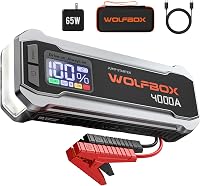
The WOLFBOX 4000A is the MegaVolt24, an 88.8Wh lithium pack rated at 4000A for 12V vehicles. The steps below take you from a flat battery to a running engine without touching another car.
What should you check before you clamp anything on?
Charge the pack and look over the clamps and cables first. A full pack and clean, undamaged clamps are the two things that make a jump go smoothly.
Plug the WOLFBOX 4000A in with its PD65W fast charger and let it fill. WOLFBOX says the 65W USB-C port gets it to full in about 1.3 hours, so a top-up before a trip takes almost no planning.
That speed matters more than it sounds. The kit ships with the PD65W charger, so you don't have to hunt for a matching wall plug, and short notice before a trip is enough to bring the pack back to full.
Check the battery posts for loose cables or heavy corrosion. If either clamp lead or the pack casing looks damaged, stop and use a different jump starter.
Confirm the vehicle is 12V before you start. The WOLFBOX 4000A is rated for 12V cars, trucks, boats, and larger vehicles, with gasoline and diesel engines under 10 liters.
Match the pack to the engine
The 10 liter engine rating is the number to check, and it applies to both gasoline and diesel. That covers the vast majority of passenger cars and light trucks, but it is a ceiling, not a suggestion.
The pack is universal fit for 12V vehicles, and its 6000 milliamp-hour lithium-ion cells are what the 88.8Wh figure comes from. The 3 pound weight and 1.5 by 3.86 by 9.33 inch body mean it fits in a glovebox corner or under a seat without a second thought.
How do you connect the WOLFBOX 4000A to a dead battery?
Red to positive, black to negative, in that order. Keep the clamp jaws clear of each other so the two leads never touch.

- Find the battery terminals, marked + and -.
- Clip the red clamp to the positive post and twist it slightly so the teeth bite.
- Clip the black clamp to the negative post.
- Keep the pack and loose cable away from moving belts and fans.
The WOLFBOX 4000A carries an IP64 rating against dust and splashing, so a damp engine bay isn't an instant problem. Still, keep the pack out of standing water and off hot surfaces.
Don't reverse the clamps. WOLFBOX lists that warning for a reason: connecting positive to negative sends current the wrong way.
If you ever do, disconnect both clamps right away before trying again.
A clean bite matters as much as the order. Rock each clamp a little once it's on so the teeth cut through surface grime, and check that neither jaw is resting on plastic trim or a painted bracket instead of the lead post.
This is the same sequence in our general how to use a portable jump starter guide, and the order matters on every pack.
What does the one-touch boost button do?
It pushes extra power into a battery sitting at low voltage. A near-dead battery that won't take a normal jump often responds to the boost.
The feature gives the WOLFBOX 4000A a second chance at the toughest cases. Press the boost button, wait the moment it needs, then turn the key or press the start button.
Some household jump packs make you press a separate override on the clamps before they will release current at all, and that step is easy to forget in the dark. On the WOLFBOX the boost lives on the pack itself as a one-touch control, so it is one press rather than a hidden button hunt.
The HD LCD screen shows the pack's status while you work, so you can see where the charge sits before and after the boost. That display also flags a low pack before you waste a jump attempt.
For a deep dive into what happens inside the pack and why the boost helps, read how does a jump starter work.
How do you actually start the car?
Turn the ignition, give it a few seconds, and stop cranking if it doesn't catch. Long cranks drain the pack and heat the starter.
Most cars fire on the first or second try with the pack connected. If it turns over slowly, let the WOLFBOX 4000A rest for a minute and try once more.
If the engine still doesn't start after two or three attempts, the problem may not be the battery. A jump starter only solves a flat battery, not a dead starter, a fuel problem, or a bad alternator.
Keep everyone clear of the engine bay while you crank. The pack has passed UL, FCC, CE, and CA65 testing, but the car is still the moving machine.
How should you disconnect the clamps?
Black off first, then red, right after the engine catches. Leave the car running so the alternator can take over the charging job.
Pull the black clamp off the negative post and set it away from the battery. Then lift the red clamp off the positive post.
The order is the reverse of connection, and it protects the pack as much as you. Breaking the negative side first means the last thing touching the battery is the positive lead, so a dropped clamp can't bridge the two posts while the engine is running.
Don't yank the clamps by the cable, and don't let the two jaws clang together on the way out. Coil the cables and tuck them back into the pack's storage area.
The WOLFBOX 4000A's one-touch boost works on vehicles under low voltage, but the manual's instructions and this order are the safety net either way.
How do you recharge and store the jump starter?
Recharge it after every use and store it somewhere that isn't freezing or baking. The pack keeps its edge when it's charged and kept at a steady temperature.
Plug in the PD65W charger and let the LCD show a full reading. The 65W USB-C port also charges phones, laptops, and iPads, which makes the pack a travel backup beyond the garage.
That port is worth knowing about before a trip. One 65W Type-C in/out port and one QC3.0 USB-A port mean the same pack that starts the car can also top up a phone or a laptop on the road, so you are not carrying two bricks.
WOLFBOX rates the pack for -4 to 140°F, so a hot trunk or a cold shed is within its range, but room temperature treats the cells best.
Top it up every few months even if you haven't used it, since a lithium pack left flat ages faster. Our guide to how to charge a jump starter covers charge times and habits in more depth.
Is the WOLFBOX 4000A the right jump starter for your car?
Yes for most cars, trucks, and boats with engines under 10 liters. It's the pack we'd hand to a driver who wants one tool for jumps, phone charging, and an emergency light.
The LED flashlight adds high-beam, strobe, and SOS modes, which earns its place in the car at night. The whole pack weighs 3 pounds and has a 2-year warranty from WOLFBOX.
Pick a different pack if your engine runs over 10 liters, or if you'd rather keep a dedicated charger for the battery at home. For those jobs, a setup like the NOCO GENIUS10 or a set of Cartman jumper cables can round out your kit.
The three tools cover different jobs, and it helps to see them side by side.
The three tools side by side
| Product | Best for | What it does |
|---|---|---|
| WOLFBOX 4000A | Roadside jumps, phone and laptop top-ups, an emergency light | 88.8Wh lithium pack, 4000A peak, 65W USB-C, LED flashlight |
| NOCO GENIUS10 | Battery upkeep in the garage | 10A 6V and 12V charger, maintainer, and desulfator |
| Cartman 4 Gauge | Jumping from another car the old way | 20 ft of 4-gauge cable sized for cars, vans, and mid-size pickups |
Once you know how to use the WOLFBOX 4000A jump starter, a dead battery becomes a 2-minute job. Charge it, clip red then black, press boost, start the car, and unclip in reverse.
A jump starter charges the battery enough to start the engine, not to fill it. If you want the longer version of why, see whether a jump starter can charge a battery on its own.
Frequently asked questions
Does the WOLFBOX 4000A need to be charged before you use it?
Yes. Charge it fully before its first use and recharge it after every jump, so the 88.8Wh pack holds enough power when you need it.
WOLFBOX says a PD65W charger fills it in about 1.3 hours.
Can the WOLFBOX 4000A start a diesel engine?
WOLFBOX rates it for both gasoline and diesel engines under 10 liters. That covers most cars, trucks, and boats, but check your engine size against the 10L limit before you rely on it.
Can you leave the clamps on after the engine starts?
No. Remove them right after the engine catches: black clamp off first, then the red.
That keeps the pack from dumping current back into the running vehicle.
Can you jump your own car with the WOLFBOX 4000A?
Yes. It's a self-contained lithium pack with its own clamps, so one person can attach it, start the car, and remove it without a second vehicle nearby.