How Does a Jump Starter Work?
A jump starter works by sending a short burst of current from its internal battery through clamps to the vehicle's electrical system, helping the starter motor crank the engine. It doesn't fully recharge a weak battery.
On this page (9 sections)
- How does a jump starter work?
- What happens between connecting the clamps and starting?
- Does a jump starter charge the car battery?
- What do amps mean when choosing a jump starter?
- Which of these jump starters suits your vehicle?
- What safety features matter, and what mistakes should you avoid?
- How is a jump starter different from jumper cables?
- How should you store and care for a jump starter?
- How should you choose now that you know how a jump starter works?
A jump starter works by sending a short burst of current from its internal battery to your vehicle's electrical system so the starter motor can turn the engine. It helps a weak car battery supply starting power without needing another vehicle.
Once the engine runs, the portable unit has finished its main job. A successful start doesn't mean the car battery is fully charged or that the cause of the flat battery has been fixed.
How does a jump starter work?
A jump starter supplies stored electrical energy through heavy cables and clamps to help crank the engine. It connects alongside the vehicle battery through the approved jump points.
Turning the key or pressing the start button engages the starter motor, which needs a large amount of current for a short time. A weak battery may power dashboard lights yet fail to supply enough current to turn the engine.
The jump starter adds a source of current during that demand. It doesn't force its full advertised output into the vehicle at all times; the current drawn depends on the electrical load and conditions.
How does a jump starter work with a nearly flat battery?
A jump starter can help a nearly flat battery, but very low voltage may prevent automatic battery detection. Some units offer a boost or override mode for this situation.
Use that mode only as the unit's manual directs, since it may change which safeguards are active. A battery that won't accept a normal connection needs a careful check before you attempt an override.
What happens between connecting the clamps and starting?
The clamps form the path that lets starting current reach the vehicle, and firm contact at the correct points is essential. A loose clamp or heavy corrosion can block useful current even when the jump starter is charged.
Prepare before opening the hood: park safely, apply the parking brake, switch the vehicle off, and turn off accessories. Find the jump points in the vehicle manual rather than assuming both clamps belong directly on the battery.
Then follow both manuals for the procedure:
- Inspect the battery, jump starter, cables, and clamps for damage.
- Confirm the vehicle voltage and check the jump starter's charge level.
- Attach the red clamp to the approved positive point and the black clamp where directed.
- Activate the unit as instructed and check its connection indicators.
- Make a start attempt within the stated crank limit.
- Once the engine runs, switch off and disconnect the unit in the specified order.
Keep cables clear of belts, fans, and other moving parts. For the full sequence, read how to use a portable jump starter, then use your manuals for model-specific steps.
Does a jump starter charge the car battery?
A jump starter isn't a full battery charger. Its main task is to provide starting current briefly, while charging restores stored energy over a longer period.
After the engine starts, a working alternator supplies electrical power and may replenish the battery. Don't assume a few minutes of idling or a short drive will restore a deeply discharged battery.
Use a compatible dedicated charger when the battery needs a proper recharge while parked. Our explanation of whether a jump starter can charge a battery covers that difference.
A battery that repeatedly goes flat needs diagnosis. Possible causes include battery wear, a charging fault, or an electrical load that stays on after the car is parked.
What do amps mean when choosing a jump starter?
Amps describe electrical current, but engine compatibility comes before the biggest peak number. Peak-current figures alone don't tell you how long a unit can support cranking or whether it suits your engine.
Start with your vehicle's voltage, fuel type, and engine size. Diesel engines generally demand more starting effort than similarly sized gasoline engines, and cold conditions can make starting harder.
Battery capacity describes stored energy rather than starting current. A larger capacity can help with reserve power, but it doesn't replace a suitable engine rating.
For a household with several vehicles, choose around the most demanding compatible vehicle. Read how many amps you need for a jump starter before comparing peak figures across brands.
Which of these jump starters suits your vehicle?
Choose by engine coverage first, then charging features and storage needs. These 3 options show how the same basic starting process can serve different drivers.
For more options across vehicle types, see our best jump starter guide.
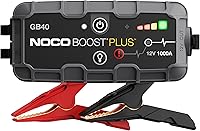
NOCO Boost GB40: for everyday cars and smaller diesels
The GB40 suits drivers who want one unit for a gasoline vehicle or a smaller diesel. It supports 12V vehicles with engines up to 6.0L gasoline or 3.0L diesel.
Its IP65-rated housing and 100-lumen flashlight suit an emergency kit that may be used outdoors or after dark. The included storage bag gives the unit and accessories a place between uses.
Choose it over the GB20 when you need diesel coverage or have a larger gasoline engine. Skip it if your engine exceeds its stated limits or you need built-in tire inflation.
Wolfbox 4000A: for larger engines and travel charging
The WOLFBOX suits drivers with larger compatible engines and travelers who also need device power. It supports 12V gasoline and diesel engines under 10L.
Its 65W USB-C input and output support laptop charging, and a PD65W charger is included. WOLFBOX states a full recharge time of 1.3 hours, which helps if you need to restore the pack before a trip.
The LCD makes status checks easier to read, while its 3 lb weight deserves space in your kit. Skip it if you want a unit only for a small gasoline vehicle and won't use the added engine coverage or charging features.
NOCO Boost GB20: for smaller gasoline vehicles
The GB20 suits drivers whose emergency kit only needs to cover a compatible smaller gasoline engine. It also includes a flashlight and power bank for use away from an outlet.
Choose it when every vehicle you plan to cover fits that gasoline limit. Its IP65-rated housing adds protection against dust and water exposure, though you should still store it dry.
Skip it for diesel vehicles or if the same pack must cover a larger family vehicle. Plan around your full set of vehicles rather than buying for the smallest one.
What safety features matter, and what mistakes should you avoid?
Connection protection helps reduce specific errors, but it doesn't replace correct setup. NOCO equips both the GB40 and GB20 with spark-proof and reverse-polarity protection.
Never let the clamps touch each other while the unit is active. Stop if a fault indicator appears, and check its meaning before changing connections or attempting a start.
Avoid these common mistakes:
- Repeated cranking: follow the maximum crank time and cooling pause in the manual.
- Wrong voltage: a 12V pack must not be treated as a solution for a different-voltage system.
- Unnecessary override use: try the normal procedure first and use boost only as directed.
- Poor clamp contact: a clamp gripping plastic or loose corrosion won't provide a sound electrical path.
- Using a damaged battery: don't jump-start one that's frozen, cracked, leaking, swollen, or unusually hot.
If the engine cranks at a normal speed but won't fire, more starting current may not solve the problem. Stop repeated attempts and seek help for the underlying fault.
How is a jump starter different from jumper cables?
A jump starter carries its own energy source, while jumper cables usually borrow power from another vehicle. That makes a charged portable pack useful in a driveway, remote parking area, or other place without a donor car.
Cables don't contain a battery that needs periodic charging, but you need a suitable power source and enough access to connect safely. A portable pack still requires care, charge checks, and a compatible vehicle.
Compare both approaches in jump starter vs jumper cables.
How should you store and care for a jump starter?
Keep the pack charged, dry, and within its manual's storage limits. Set a reminder for the recommended charge checks instead of waiting for a breakdown to discover it's low.
Recharge after a start attempt and after using the power bank. Phone or laptop charging draws from the same stored energy you may need for the next emergency.
Keep the clamps secured so they can't touch or damage other items. Check for loose connections, damaged insulation, swelling, or a cracked case before use.
Extreme heat and cold affect batteries, so don't assume a unit's operating range also describes safe charging or storage conditions. Follow the separate limits in its manual and read how to charge a jump starter for charging basics.
How should you choose now that you know how a jump starter works?
Pick the GB20 for smaller gasoline vehicles, the GB40 for broader everyday coverage, or the WOLFBOX for larger compatible engines and laptop charging. Check every vehicle you intend to cover before choosing.
Knowing how a jump starter works also tells you its limit: it supplies starting power, while repeated discharge needs a separate fix. Use our guide to how to choose a jump starter to turn your engine size, climate, and storage needs into a final choice.
Frequently asked questions
How does a portable jump starter start a car?
A portable jump starter supplies current from its own battery to help the starter motor turn the engine. Its clamps connect to the vehicle's approved jump points, completing the electrical path.
It can help when the vehicle battery is weak, but it won't repair a failed starter or another engine fault.
Does a jump starter charge a dead car battery?
No, a jump starter provides brief starting power rather than a full battery recharge. A working charging system may restore some charge once the engine runs, but a short drive may not be enough.
Use a compatible battery charger when needed, and have repeated battery discharge checked.
What do the clamps do on a jump starter?
The clamps carry current between the portable battery and the vehicle's electrical system. Red connects to the approved positive point, while black connects where both manuals direct, often a designated ground point.
Firm contact matters because a loose connection can prevent enough current from reaching the starter motor.
Is it safe to use a jump starter?
A compatible jump starter can be used safely when you follow both manuals and inspect the equipment first. Never use one on a frozen, cracked, leaking, swollen, or unusually hot battery.
Connection protection helps reduce certain mistakes, but it doesn't make an unsuitable battery or incorrect procedure safe.