5 Best Jump Starter with Air Compressor (November 2026)
The best jump starters with air compressors include the Wolfbox MV24A for pickup owners, the Gooloo A3 for family car kits, and the Wolfbox MV16A for frequent top-ups.
On this page (8 sections)
- Which is the best jump starter with air compressor for your vehicle?
- How do you choose the right engine capacity and compressor?
- What should you set up before the kit goes in your car?
- How should you use the jump starter and inflator safely?
- How do you keep a combo unit ready for an emergency?
- Which common mistakes waste the most time or battery?
- Is a jump starter and compressor combo worth carrying?
- Which jump starter with an air compressor should you choose?
The best jump starter with air compressor for most drivers is the Wolfbox MV24A, especially for pickup owners who want broad engine support and useful airflow. The Gooloo A3 fits family car kits, while the AstroAI S8 Air suits drivers who want easier carrying.
Choose around your vehicle and tire needs first. Phone charging, lights and extra nozzles matter only after the unit can handle your engine and the inflation jobs you expect.
For a broader overview of booster styles, start with our portable car jump starter buying guide. If output figures are your main concern, read how many amps you need for a jump starter.
Our picks at a glance
-
1

-
2
-
3

Which is the best jump starter with air compressor for your vehicle?
The MV24A is the strongest all-around fit here for pickup owners, while the other choices serve more specific needs. Match engine support first, then choose between inflation controls, carrying weight and charging features.
We compared engine limits, compressor airflow, controls, charging connections and storage needs. Brand inflation examples help show the scale of a job, but different tires and starting pressures prevent a direct speed ranking.
| Product | Best for | Peak current | Air pressure | Engine support | Our score |
|---|---|---|---|---|---|
| Wolfbox MV24A | pickup owners | 4,000A | 160 PSI | Up to 10L gas or 10L diesel | 8.3 |
| Gooloo A3 | family car kits | 3,000A | 150 PSI | Up to 9.0L gas or 6.5L diesel | 7.9 |
| Wolfbox MV16A | frequent top-ups | 3,000A | 160 PSI | Up to 8L gas or 6L diesel | 7.8 |
| AstroAI S8 Air | easier carrying | 3,000A | 150 PSI | Up to 9L gas or 6.5L diesel | 7.7 |
| Gooloo A5 | road-trip device charging | 4,000A | 160 PSI | All gas engines or up to 10L diesel, per Gooloo | 7.5 |
Wolfbox MV24A: Best for pickup owners
- 4,000A peak current
- 160 PSI compressor
- 45 L/min airflow
- 65W USB-C port
The MV24A suits pickup owners who want broad engine support and a compressor for tire top-ups. Its charging and DC output options also help on road trips.
Pros
- WOLFBOX rates it for up to 10L gas or 10L diesel engines
- 65W USB-C port
- 400-lumen light with distress, strobe and high beam modes
Cons
- Charging adapter is not included
- Pickup inflation example covers a small pressure increase
The MV24A suits drivers who want one emergency kit for a larger engine and pickup tire top-ups. WOLFBOX rates its 4,000A peak output for engines up to 10L gas or 10L diesel.
Its compressor reaches 160 PSI with 45 L/min airflow. WOLFBOX gives a pickup example of raising a 315/70 R17 tire from 30 PSI to 36 PSI in 2 minutes 30 seconds, which shows a modest top-up rather than a refill from flat.
The 88.8Wh battery also supports USB-A ports and 160W continuous DC output. Check the power needs and connection of any accessory before planning to run it from the pack.
A 65W USB-C port supports charging, and WOLFBOX says a full recharge can take as little as 2 hours with suitable equipment. A charging adapter isn't included, so account for that before putting the kit in your vehicle.
The included EVA bag keeps the unit and accessories together, and a 400-lumen light offers distress, strobe and high beam modes. Skip this model if easier carrying matters more than its engine range; the S8 Air serves that buyer better.
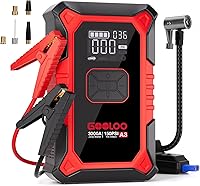
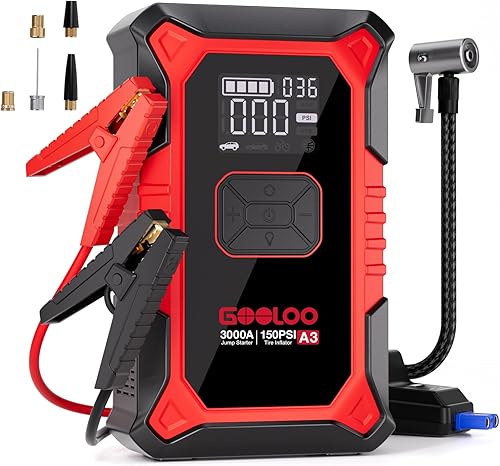
Gooloo A3: Best for family car kits
- 3,000A peak current
- 150 PSI compressor
- Five inflation modes
- Five nozzles
The A3 fits households that want one kit for a car, bicycles and sports balls. Custom pressure settings and automatic shutoff make it useful beyond roadside emergencies.
Pros
- Five inflation modes and nozzles
- Auto shutoff and digital pressure display
- Gooloo specifies 10 protection features
Cons
- Lower airflow than the Wolfbox models
- Charging temperature range is 14°F to 113°F
The Gooloo A3 fits a household that wants to handle car tires, bike tires and sports balls with the same kit. Its five inflation modes cover SUV, car, bike, ball and custom settings, with five nozzles included.
The custom mode matters because a preset category cannot know the pressure required by your exact tire. Enter the right target, watch the digital pressure display and let automatic shutoff stop the pump at that setting.
Gooloo rates the 3,000A booster for up to 9.0L gas or 6.5L diesel engines. The compressor reaches 150 PSI and has 35 L/min airflow, placing it below the Wolfbox models on that airflow measure.
USB device charging and a flashlight add everyday uses. Gooloo specifies 10 protections, including reverse connection, overheating and overcharge protection, but correct clamp placement still comes first.
Choose the A3 for a shared family kit; skip it if your diesel engine exceeds its range or larger tire work is your main priority. Our Gooloo A3 review takes a closer look at its controls and fit.
Wolfbox MV16A: Best for frequent top-ups
- 3,000A peak current
- 160 PSI compressor
- 65W USB-C port
- 59.2Wh battery
The MV16A suits drivers whose engines fit its range and who want the same compressor airflow as the MV24A. Fast USB-C charging helps when the kit sees regular use.
Pros
- 65W USB-C port
- 160 PSI compressor rated at 45 L/min
- 400-lumen light with three modes
Cons
- Lower stated engine range than the MV24A
- Charging adapter is not included
The Wolfbox MV16A makes sense when your engine fits its limits and you want quick recharging after regular tire maintenance. Its 59.2Wh battery is smaller than the MV24A's, while both have the same stated compressor airflow.
WOLFBOX rates the MV16A's 3,000A peak output for up to 8L gas or 6L diesel engines. That makes engine fit the main reason to choose between these two Wolfbox units.
The compressor reaches 160 PSI at 45 L/min. Those figures suit a buyer focused on tire top-ups who doesn't need the MV24A's broader engine range.
WOLFBOX says the 65W USB-C connection can recharge the MV16A in as little as 1.5 hours with suitable equipment. A compatible charging adapter is a separate need, so check what you already have.
The unit also includes 160W continuous DC output, a 400-lumen light and an EVA bag. Skip it if your engine sits beyond its stated limit; sharing compressor specifications with the larger model doesn't give it the same jump-start capacity.
AstroAI S8 Air: Best for easier carrying
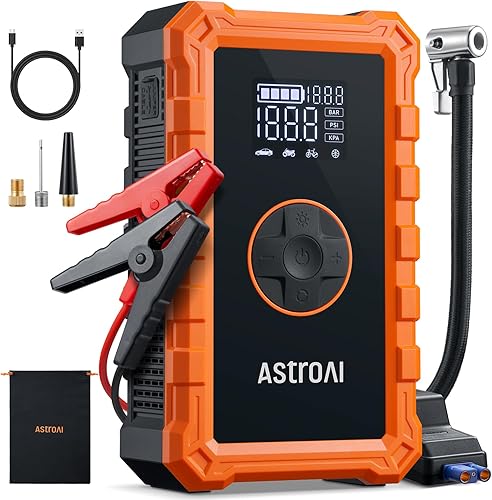
- 3,000A peak current
- 150 PSI compressor
- 2.4-inch screen
- 2.4 lb weight
The S8 Air suits drivers who carry their emergency kit between vehicles or indoors for charging. Its screen shows pressure, battery level and operating status, and accessories store in the unit.
Pros
- 2.4 lb weight
- Auto-stop inflation with preset modes
- Accessories store in the unit
Cons
- Compressor needs at least a 10-minute rest after 10 minutes of continuous operation
- Lower airflow rate than the Wolfbox models
The AstroAI S8 Air is the pick for drivers who regularly carry the kit indoors or move it between vehicles. Its 2.4 lb weight and built-in accessory storage make that job easier.
AstroAI rates the 3,000A booster for up to 9L gas or 6.5L diesel engines. A 2.4-inch screen shows battery level, operating status and error codes, plus target and current pressure during inflation.
The compressor reaches 150 PSI with 25 L/min airflow. Five preset modes and automatic shutoff help with routine inflation, but the lower airflow makes it less appealing for buyers focused on larger tire jobs.
AstroAI requires at least 10 minutes of rest after 10 minutes of continuous compressor use. That pause matters if you plan to work through several tires rather than add a little air to one.
The air tube can become hot, so let it cool before removal. Choose the S8 Air for carrying and storage convenience; skip it if your normal task involves long inflation sessions with few breaks.
Gooloo A5: Best for road-trip device charging
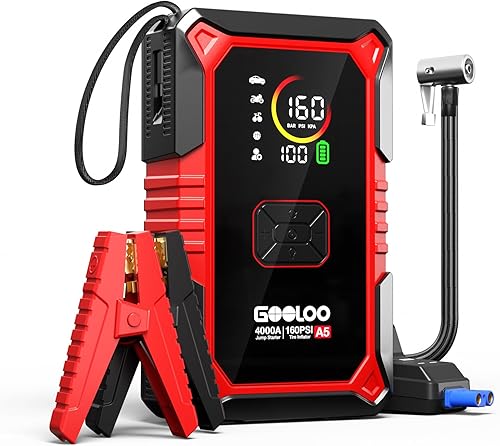
- 4,000A peak current
- 160 PSI compressor
- Built-in 45W USB-C output cable
- 74Wh battery
The A5 suits road trips where phone charging matters alongside tire and battery support. Its integrated USB-C output cable reduces the loose cables needed for compatible devices.
Pros
- Built-in 45W USB-C output cable
- Auto-stop inflation
- Five modes and five nozzles
Cons
- Charging temperature range is 14°F to 113°F
- Built-in USB-C cable is output-only
The Gooloo A5 fits road trips where a compatible phone may need power alongside roadside battery and tire support. Its built-in 45W USB-C cable means one less loose cable to find.
That cable is output-only, so it cannot recharge the A5. Keep the separate charging cable with the kit and make sure everyone sharing the vehicle understands the difference.
Gooloo rates the 4,000A unit for 12V vehicles with all gas engines or diesel engines up to 10L. Confirm compatibility for your exact vehicle rather than treating the broad gas-engine claim as permission for every application.
The 160 PSI compressor has five modes, five nozzles and automatic shutoff. Gooloo's example raises a 285/70 R17 pickup tire from 30 PSI to 36 PSI in 2 minutes, using a different tire from WOLFBOX's example.
The A5 has a 74Wh battery and weighs 3.2 lb. Choose it if integrated device charging will earn its place in your kit; skip it if you rarely need that feature and carrying weight matters more.
How do you choose the right engine capacity and compressor?
Choose a combo unit that supports your engine and your normal tire job. Peak amps and maximum PSI describe different functions, and neither number tells the whole story.
Match a jump starter with air compressor to your engine
Start with battery voltage, fuel type and engine displacement. These picks are for 12V systems, so don't use them on a different voltage system.
Use the vehicle's manual to identify approved jump points and any restrictions. A battery hidden under a seat or in the trunk may have remote connection points under the hood.
Stay within the brand's stated engine range. If you're choosing near a model's upper limit, especially for a diesel used in cold weather, favor more suitable engine capacity over extra phone-charging features.
A larger peak-current figure doesn't prove stronger performance in every situation. Battery condition, temperature and the quality of the clamp connection all affect whether the engine starts.
For larger diesels, compare the options in our jump starter guide for diesel trucks. Our guide to choosing a jump starter covers the broader fit checks.
Match airflow and run time to the tires
Prioritize airflow and allowed run time for larger tires. Maximum pressure matters only after the compressor can reach the pressure your vehicle requires.
A pump's airflow figure doesn't mean it delivers that same volume at every pressure. Use it as one comparison point alongside tire examples, operating limits and the size of your expected job.
Adding a few PSI to a sedan tire is a smaller task than filling a large pickup tire from very low pressure. Don't turn a brand's short top-up example into an estimate for a flat tire.
For frequent work on several large tires, consider a separate compressor with an explicit duty cycle suited to that job. A portable combo earns its place through emergency convenience.
Choose controls that suit the person using them
Prefer automatic shutoff if you want help stopping at a set pressure, but check the target yourself. Car, SUV and bike modes are starting points, not vehicle-specific instructions.
Make sure you can select the pressure unit you use and read the display without confusion. Mixing PSI, BAR and kPa can lead to a badly wrong setting.
For bikes and other inflatables, check valve and nozzle fit before buying. A suitable pressure range doesn't guarantee that every valve connection will work with the supplied accessories.
What should you set up before the kit goes in your car?
Fully charge the pack, learn the controls and pack every required accessory before relying on it. A complete kit should be ready to use without searching through the house for a hose or charging cable.
Read the manual at home and identify the jump-start socket, compressor controls and charging input. Learn what its warning lights mean before a roadside problem puts you under pressure.
Check the charging adapter's output and cable requirements, especially if you want a fast recharge. A USB-C connector alone doesn't mean your existing adapter can provide the required power.
Find the recommended tire pressures on the vehicle placard or in the owner's manual. Note any difference between front and rear tires or between normal and loaded use.
Locate the battery terminals or remote jump points while the car is parked safely. Check whether the clamps can reach those points with the unit resting on a stable surface.
Keep the hose, clamps, nozzles and charging cable in one case. Store the kit where you can reach it without unloading everything you normally carry.
If several people use the car, show each person the correct charging connection and where the manual is kept. Shared access is useful only if everyone can find and operate the kit.
How should you use the jump starter and inflator safely?
Follow the vehicle and pack manuals for each function, and work only where you can stand clear of traffic. If the location is unsafe, roadside help takes priority over using the tool.
Starting the vehicle
Switch off the vehicle and unnecessary electrical loads before connecting the pack. Inspect the battery and don't attempt a jump if it is leaking, cracked, swollen or suspected to be frozen.
Use the approved connection points and follow the specified clamp sequence. Keep the leads away from fans, belts and other moving parts, and don't let the clamps touch each other.
If a model has a boost or override button, use it only under the conditions described in its manual. Bypassing normal battery detection requires extra care with polarity.
Keep cranking attempts within the stated limits and allow the required pause between them. Repeated attempts won't solve a fuel, starter or mechanical fault and can overheat equipment.
After a successful start, disconnect as directed and arrange a battery or charging-system check if the cause is unclear. One successful boost doesn't explain why the battery went flat.
Inflating a tire
Use the vehicle's recommended cold tire pressure, not the maximum pressure molded into the tire sidewall. Warm tires can read higher after driving, so recheck them cold rather than bleeding them down to a cold target.
Inspect the tire before adding air. Cuts, bulges, a loose valve or damage from driving flat call for more than a pressure top-up.
Attach the hose securely, confirm the pressure unit and enter the target. Stay nearby while the pump runs, even if automatic shutoff is available.
Stop if you hear a strong leak, see an implausible pressure reading or notice a fault warning. Check the hose connection and follow the manual's troubleshooting steps before continuing.
Let hot parts cool before handling or packing them. Confirm the final pressure with a separate gauge, replace the valve cap and check again if the tire has been losing air.
How do you keep a combo unit ready for an emergency?
Check charge on a schedule and recharge after use. Jump-starting, inflation and device charging all draw from the same stored energy, so a pack used for weekend chores may need attention before Monday.
Gooloo calls for recharging the A3 and A5 at least every 3 months during storage. AstroAI recommends a recharge every 2–3 months for the S8 Air; follow the Wolfbox manual for its maintenance schedule.
Check sooner after a long trip or a period of frequent use. The battery indicator is more useful than assuming an unused pack must still be full.
Charging limits can be narrower than operating limits. Gooloo specifies 14°F to 113°F for charging the A3 and A5, so bring a very cold or hot unit into suitable conditions before plugging it in.
Avoid prolonged heat, moisture and direct sunlight, and follow each model's storage limits. Don't leave the pack loose where it can slide into other tools or suffer repeated knocks.
Inspect cables, clamp insulation, hose connections and the case during charge checks. Replace damaged parts through the proper support channel rather than improvising a repair to high-current leads.
Use phone charging with a reserve in mind. If you expect to need the booster or inflator, avoid using the pack as your main everyday power bank.
Which common mistakes waste the most time or battery?
The biggest mistakes are choosing by headline numbers and treating the kit as ready without checking it. Avoid these habits:
- Buying by peak amps alone. Confirm voltage, engine size and fuel type before comparing extras.
- Confusing tire pressure with inflation speed. A high PSI ceiling doesn't show how long a large tire will take.
- Using the wrong pressure target. Read the vehicle placard and verify the selected unit before starting the compressor.
- Ignoring compressor breaks. Follow the allowed run time, even if another tire still needs air.
- Starting with little charge left. A partly drained pack may have already powered phones or inflated several tires.
- Repeating boosts without finding the cause. A recurring flat battery needs diagnosis, and a tire that keeps losing air needs attention.
- Packing hot equipment immediately. Allow the hose and compressor to cool before closing the case.
Keep the two roadside jobs separate in your planning. Unless the manual permits simultaneous use, finish one function before moving to the other.
Is a jump starter and compressor combo worth carrying?
A combo is worth carrying if both battery trouble and tire top-ups are realistic needs and you prefer one kit. It saves you from managing two rechargeable tools, but also puts both functions behind one battery.
Separate tools make more sense for frequent inflation, demanding tire jobs or a vehicle that needs a more specialized booster. Compare our best jump starter picks if the engine-starting task should drive the whole purchase.
An inflator won't repair a puncture or make a damaged tire safe. Likewise, a jump starter supplies starting power rather than a controlled, full recharge for the car battery.
Read our comparison of a jump starter vs. battery charger if the vehicle sits unused or needs regular battery charging. Those needs may call for a charger alongside your emergency kit.
Which jump starter with an air compressor should you choose?
Choose the best jump starter with air compressor by deciding which job must come first. Engine compatibility is the entry requirement; your tire routine and carrying habits settle the choice.
Pick the Wolfbox MV24A for pickup ownership and broader engine support. Choose the Gooloo A3 for a family kit that will also handle bikes and balls.
The Wolfbox MV16A suits engines within its range when quick recharging and tire top-ups matter most. Pick the AstroAI S8 Air if you carry the kit often and can work within its compressor rest schedule.
Choose the Gooloo A5 when its integrated device-charging cable will be useful on road trips. Before storing any choice in your car, charge it fully and work through our guide to how to use a portable jump starter.
Our top 3 picks at a glance
-
1
-
2
-
3
Frequently asked questions
Can a jump starter with an air compressor start a car and inflate a tire?
Yes, a combination unit can boost a compatible vehicle and inflate a tire, but use each function separately unless its manual permits otherwise. Both tasks draw from the same battery, so check the charge before starting.
Engine limits, tire size and compressor rest periods still apply.
How much peak current should a jump starter with a compressor have?
Choose by your vehicle's voltage, engine size and fuel type before comparing peak current. These picks have 3,000A or 4,000A peak figures, but their engine limits differ.
Cold conditions and battery condition also matter.
Our guide to how many amps you need explains the main sizing choices.
Can these compressors inflate pickup truck tires?
Yes, WOLFBOX and Gooloo provide pickup tire top-up examples for models in this group. Those examples cover modest pressure increases in specific tire sizes, so they don't predict inflation time from flat.
Check your required pressure, tire condition and compressor duty limits before relying on one for a truck.
What should I check before using the jump starter?
Confirm vehicle compatibility, charge the pack and read both manuals before connecting anything. Locate the approved jump points and inspect the battery for damage.
For inflation, use the vehicle's recommended tire pressure and inspect the hose.
Our guide to using a portable jump starter covers the basic connection process.
Does automatic shutoff mean I can leave the inflator unattended?
No, stay beside the inflator even when it has automatic shutoff. You still need to enter the correct pressure, secure the hose and watch for leaks, unusual readings or excess heat.
Stop if something looks wrong, and check the final pressure with a separate gauge after inflation.