How Many Amps Do You Need for a Jump Starter?
How many amps you need for a jump starter depends on your engine: 500 to 1,000 peak amps covers many passenger cars within the starter's stated limits. Match vehicle voltage, engine size, and fuel type first, then allow room for harder starting conditions.
On this page (7 sections)
- How many amps do you need for a jump starter?
- What do peak amps actually tell you?
- Which of these jump starters fits your vehicle?
- Do diesel engines and cold weather change your choice?
- What should you check before connecting a jump starter?
- How do you keep a jump starter ready?
- Which amp rating should you choose now?
For many passenger cars, 500 to 1,000 peak amps is a useful starting range when deciding how many amps you need for a jump starter. The right model must also match your vehicle's voltage, engine size, and fuel type.
A larger number can widen your options, but it doesn't replace those checks. Buy for the hardest vehicle you need to start, then consider charging speed, storage, and how easily you can attach the clamps.
How many amps do you need for a jump starter?
Choose by the starter's supported engine size first, using peak amps to compare models after you confirm compatibility. Small gas cars can use lower-output units, while larger engines and diesels usually need more starting power.
Before shopping, write down these details:
- Starting-system voltage: Confirm it in the vehicle manual.
- Engine displacement: Find the size in liters, such as 2.0L or 5.7L.
- Fuel type: Use the gas or diesel limit that applies.
- Other vehicles: Include any family car, truck, or equipment you expect to help start.
Don't size a shared jump starter around your smallest car. Choose one that covers the most demanding compatible vehicle, especially if you'll carry it between cars.
For a broader sizing overview, see what size jump starter you need. Our jump starter choosing guide covers the features to compare after that fit check.
What do peak amps actually tell you?
Peak amps describe a brief maximum current output, not the current a starter can sustain throughout every starting attempt. The engine, battery, cables, clamp contact, and temperature all affect how much useful power reaches the starter motor.
A bigger jump starter doesn't force its full advertised current into the vehicle. A compatible starting system draws the current it needs, so voltage compatibility matters more than matching an exact amp number.
How many jump starter amps do you need compared with battery CCA?
You don't need to match peak amps to battery CCA because they measure different things. Cold cranking amps describe a vehicle battery's ability to supply current under defined cold conditions; a jump starter's peak figure isn't a direct substitute.
For example, a battery marked 600 CCA doesn't automatically require a jump starter advertised at 600 peak amps. Use the jump starter's engine guidance rather than treating those numbers as equal.
Amp-hours and milliamp-hours describe stored charge, another separate measure. Neither tells you on its own whether a pack can deliver the short burst your engine needs.
Which of these jump starters fits your vehicle?
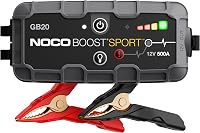
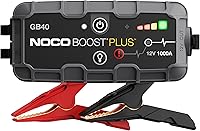
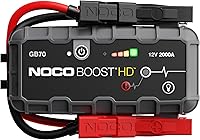
The GB20 suits smaller gas vehicles, the GB40 covers a wider everyday range, the GBX45 adds faster charging, and the GB70 fits larger engines. All 4 are 12V models, so confirm your starting-system voltage before choosing.
NOCO Boost GB20: for a smaller gas vehicle
Choose the GB20 when you're buying for a compatible gas car or smaller engine and want a compact emergency pack. It makes sense for a dedicated vehicle kit where you know exactly which engine it needs to support.
Skip it for a diesel vehicle or a household whose larger gas engine exceeds its range. If your engine sits at its upper limit and winter starts are a concern, choose a model with a wider supported range.
NOCO Boost GB40: for broader everyday coverage
The GB40 suits drivers who want one pack for several compatible passenger vehicles, including a small diesel. Its wider coverage makes it a practical step up when the smaller model would leave another household vehicle out.
NOCO gives it a 3-hour recharge time, making it suitable for drivers who can recharge after use at home. Skip it if your diesel exceeds its supported range or fast replenishment is a main buying priority.
NOCO Boost GBX45: for drivers who value fast recharging
Choose the GBX45 if you want a wider engine range alongside 60W USB-C input and output. That port also lets it serve as a power bank for compatible phones, tablets, and laptops.
NOCO states a 48-minute recharge through USB-C Power Delivery, so pair it with suitable charging equipment. A slow USB source won't deliver that charging speed.
Its 60-second output timer also matters: follow the manual's timing procedure rather than expecting it to stay ready indefinitely after activation. Skip it if you mainly need support for an engine beyond its range.
NOCO Boost GB70: for larger engines and shared emergency kits
The GB70 suits drivers of larger compatible gas or diesel vehicles. It's also the strongest fit here for a shared kit that must cover a wider spread of engine sizes.
The tradeoff is carrying a 5 lb pack and planning around NOCO's stated 6-hour recharge time. Skip it if you only need support for a small gas car and value easier storage over wider engine coverage.
For more choices beyond these models, compare our best jump starters by your vehicle and charging needs.
Do diesel engines and cold weather change your choice?
Diesel engines and cold conditions both increase starting demands, so leave room within the supported engine range when practical. There isn't a reliable rule that adds the same number of amps for every diesel or winter morning.
Diesels need more effort to crank because of their higher compression. Cold also reduces battery output and makes engine oil harder to move, putting more strain on the starting system.
For a diesel truck, use the separate diesel limit and confirm the battery arrangement. Two batteries don't automatically tell you the system voltage; follow the truck manual and our guide to jump-starting a diesel truck.
A higher peak figure alone doesn't guarantee low-temperature performance. Check the pack's permitted operating and storage temperatures, and never try to jump-start a frozen, leaking, swollen, or visibly damaged vehicle battery.
Read how cold weather affects a car battery if slow starts return each winter. Repeated trouble deserves a battery and charging-system check rather than repeated boosts.
What should you check before connecting a jump starter?
Confirm voltage, battery condition, and the correct connection points before attaching the clamps. Some vehicles use remote jump terminals, so the battery itself may not be the right place to connect.
Read both manuals while you're at home, then keep them accessible in the vehicle. These setup checks matter more than adding another few hundred advertised amps:
- Park safely, apply the parking brake, and switch off the ignition and accessories.
- Inspect the pack, cables, clamps, and vehicle battery for damage.
- Locate the positive terminal and the designated ground or negative connection specified by the vehicle manual.
- Attach and activate the starter in the order its instructions require.
- Follow the allowed cranking time and pauses between attempts.
- After starting, switch off and disconnect the unit as directed.
The NOCO models here include spark-proof and reverse-polarity protection. Those features help with connection errors, but you still need to identify the terminals correctly.
If the engine doesn't start, stop and check the connections and warning indicators before trying again. Repeated long cranking attempts can overheat equipment, and a jump starter won't solve a fuel, ignition, or mechanical fault.
How do you keep a jump starter ready?
Recharge after use and check the charge regularly, following the pack's storage guidance. A discharged pack can't provide its intended output, regardless of the amp number printed on it.
Charge it before the first trip and set a reminder based on the manual's recommended interval. Our guide to charging a jump starter explains how to match the cable and power source.
Secure the pack so it can't slide around or damage its cables. Keep clamps protected, avoid crushing the case, and observe the stated storage-temperature limits.
Using the pack to charge electronics also uses its emergency reserve. Refill it afterward rather than assuming there's still enough charge for a difficult start.
Which amp rating should you choose now?
The answer to how many amps you need for a jump starter is the lowest suitable model that covers your vehicle and leaves sensible room for your conditions. Choose the GB20 for a smaller gas vehicle, the GB40 for broader everyday coverage, the GBX45 for faster charging, or the GB70 for larger engines.
Before ordering, confirm engine size, fuel type, voltage, and access to the jump points. Before your first roadside use, review how to use a portable jump starter so the pack is familiar when you need it.
Frequently asked questions
How many amps do I need to jump-start a car?
A starter rated at 500 to 1,000 peak amps can cover many passenger cars within its stated engine limits. Check your vehicle's voltage, engine size, and fuel type before choosing.
Larger engines, diesel engines, and difficult winter starts call for closer attention to the starter's supported engine range.
Is a 1000-amp jump starter enough?
A 1,000-amp jump starter can be enough when its engine limits cover your vehicle. NOCO rates the GB40 for gas engines up to 6.0L and diesel engines up to 3.0L.
That does not make every starter with the same peak number suitable for those engines; compare each model's stated limits.
Do diesel engines need more jump starter amps?
Diesel engines generally need more starting current than similar-size gas engines because they take more effort to crank. Use the starter's separate diesel engine limit rather than its gas limit.
Also confirm the truck's starting-system voltage, especially if it has multiple batteries or a commercial vehicle setup.
Does cold weather affect the amps I need?
Cold weather increases starting demands, but there is no fixed number of extra amps to add. Choose a compatible starter with some room above your engine size and check its permitted temperatures.
Keep it charged, follow its storage instructions, and never attempt to jump-start a frozen vehicle battery.