How to Choose a Jump Starter
To learn how to choose a jump starter, start with your vehicle’s voltage, fuel type and engine size. Then compare connection protections, clamp access, charging needs and storage space; all four models here are for compatible 12V vehicles.
On this page (8 sections)
- How to choose a jump starter for your vehicle
- How much do peak amps and battery capacity matter?
- What safety and convenience features deserve priority?
- Which jump starter fits each kind of buyer?
- What should you do when the jump starter arrives?
- How should you use and care for a portable jump starter?
- What mistakes should you avoid before buying?
- How to choose a jump starter: which option should you buy?
To understand how to choose a jump starter, match your vehicle’s voltage, fuel type and engine size first, then choose a pack you can connect, store and keep charged. A large peak-amp number is useful only after the unit fits your vehicle.
These four options serve compatible 12V vehicles, with different engine limits and charging features. For a broader overview of formats and features, see our portable car jump starter buying guide.
How to choose a jump starter for your vehicle
Choose a starter that supports your electrical system and engine, then check the vehicle’s jump-start procedure. Engine size alone is not enough to confirm compatibility.
Start with voltage, fuel type and displacement
Find the vehicle’s system voltage, whether it runs on gas or diesel, and its engine displacement in liters. Use the owner’s manual or vehicle specifications rather than guessing from the vehicle’s size.
A diesel often needs more starting effort than a similar-size gas engine. That is why a jump starter can have separate gas and diesel limits.
Do not assume every truck, RV or boat uses the same electrical setup. A compatible engine size does not make a 12V starter suitable for a 24V system.
For hybrids and electric vehicles, follow the vehicle’s specific instructions for its low-voltage system. Never connect a portable jump starter to a high-voltage traction battery.
How to choose a jump starter for several vehicles
Choose for the most demanding compatible vehicle you plan to help. Then confirm that the same pack supports the other vehicles, including their approved connection points.
Write down each engine size before comparing models. This avoids buying for a small commuter car and later expecting the same pack to cover a much larger diesel.
Check access as well as engine fit. Some vehicles use remote jump points, and the clamps need room to attach securely without stretching the cables.
If you own a diesel truck, our guide to jump starting a diesel truck explains the vehicle-specific checks to make before connecting a pack.
Leave room for demanding conditions
Choose more engine coverage when your vehicle sits near a model’s stated limit, especially if winter use is likely. Cold weather, a low pack charge and poor terminal contact can all make starting harder.
Extra capacity cannot overcome an incompatible electrical system or a mechanical fault. It gives you a reason to consider a larger suitable model, rather than a promise that every failed start can be solved.
How much do peak amps and battery capacity matter?
Use engine compatibility first and peak amps second. Peak current describes a brief output figure, while battery capacity concerns stored energy.
A bigger amp number does not mean a pack will start a vehicle several times faster. It also does not tell you the condition of the vehicle battery or how much charge remains in the starter.
For a closer explanation of current figures, read our jump starter amp guide.
Compare capacity numbers with care
Compare watt-hours when available, and do not rank packs by milliamp-hours alone. Milliamp-hour figures need a voltage reference to make a fair energy comparison.
A large stored-energy figure can matter if you also charge devices during travel. For a pack kept only for emergencies, maintaining its charge is more useful than choosing by capacity alone.
Claims about starts per charge also depend on conditions. Do not plan repeated roadside attempts around an advertised maximum.
Know when you need a charger instead
Choose a jump starter for a short burst of starting power. Choose a suitable battery charger when the job is to restore a battery’s charge over time.
A vehicle that repeatedly needs help has a problem to investigate, such as a weak battery, charging fault or unwanted electrical drain. Keeping a larger jump starter in the trunk does not resolve that cause.
Our jump starter vs battery charger guide helps you decide which tool fits the problem.
What safety and convenience features deserve priority?
Prioritize clear indicators, secure clamps and connection protections before extra ports or light modes. You need to understand what the device is telling you when the vehicle will not start.
Connection protections and boost controls
Reverse-polarity protection helps address reversed clamp connections. Other protections can respond to faults such as excessive current or a short circuit, depending on the model.
Do not choose solely by the number of protections advertised. Read what each protection does and how the unit signals an error.
A boost button needs particular care. Depending on the design, it may enable starting when normal low-voltage detection will not, so use it only under the conditions described in the manual.
Never treat boost as a way to ignore a warning. If you cannot confirm the battery’s condition, polarity or correct connection points, stop and get help.
Clamp access and readable controls
Check where the battery or remote jump points sit before buying. Deep covers, crowded engine bays and narrow terminal access can make a clamp awkward to place.
The jaws need firm contact with the approved connection points. A clamp that rests loosely on a cover or barely catches an edge is not ready for starting.
A screen can make charge and status easier to read, while indicator lights can keep controls simple. Choose the format you can understand without guessing at colors or symbols.
Storage size and useful extras
Measure your intended storage space with the case and cables in mind. A pack that fits by itself may need more room once everything is packed together.
A flashlight helps you see labels and connection points after dark. Keep a separate light available if you need both hands free to position clamps.
USB charging is useful on trips, but using the pack for phones reduces its remaining reserve. Recharge after device charging instead of assuming there is still enough energy for an emergency start.
Which jump starter fits each kind of buyer?
Choose the NOCO or AstroAI for their smaller engine ranges, and consider Gooloo or Wolfbox when you need broader engine coverage. Charging equipment, weight and controls then help separate the options.
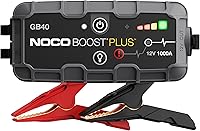
NOCO Boost GB40: for drivers who value connection protections
The NOCO Boost GB40 suits drivers of compatible vehicles up to 6.0L gas or 3.0L diesel who want spark-proof and reverse-polarity protection. Its 1000A peak output should be considered alongside that engine range.
At about 2.4 to 2.5 lb, it is easier to carry than the Gooloo below, though it is not the lightest choice here. The IP65-rated housing and rubberized covering are useful features for an emergency kit.
Its 100-lumen light has 7 modes, and the power-bank function supports emergency device charging. Those extras make sense for a driver who wants roadside lighting without adding a separate large power pack.
Choose it for a compatible car and a simple emergency role. Skip it if your engine exceeds its limits or you want the Wolfbox’s display and higher-power USB-C charging.
The included USB-C cable belongs with the pack’s charging kit. Keep its storage bag and clamps together so the unit is ready to retrieve.
Gooloo GP4000: for larger engines and shared vehicle kits
The Gooloo GP4000 suits buyers who need one pack for a wider range of compatible vehicles. Gooloo rates its 4000A model for all gasoline engines and diesels up to 10.0L on supported 12V systems.
Its dual USB outputs, including one with fast charging, are useful for a shared road-trip kit. The USB-C charging port accepts 5V/3A input, so plan around its charging requirements rather than assuming any cable and adapter combination is ideal.
The all-metal clamps, flashlight and included EVA case give you a place to keep the starting equipment together. A wall charger is not included, which makes checking your charging setup an early task.
Choose it for broader engine coverage and several device connections. Skip it if minimum carry weight matters most, since it weighs 3.9 lb.
Its boost control also makes reading the manual worthwhile before an emergency. Learn the normal indicators first so you do not reach for boost simply because the first attempt fails.
Wolfbox 4000A: for visible status and faster recharging
The Wolfbox 4000A suits drivers who want an LCD screen and 65W USB-C input/output. Wolfbox supports compatible gas and diesel engines under 10L, so do not round an engine at that boundary down.
The 88.8Wh pack includes a PD65W charger, and Wolfbox claims a full recharge in 1.3 hours. That combination is useful if you regularly bring the pack indoors to recharge between trips.
Its USB-A output and USB-C port also suit travel electronics, including compatible laptops. Check your device’s charging requirements before relying on the pack as a travel power source.
Choose it when readable status and recharge speed matter. Skip it if you only need a lightweight car backup and will rarely use the extra charging functions.
It weighs 3 lb and has an IP64 protection rating. Its one-touch boost function still requires the correct connection procedure, and Wolfbox specifically warns against reversing clamp polarity.
AstroAI S8: for drivers who prioritize low weight
The AstroAI S8 suits drivers who want a 430 g pack for a compatible car, motorcycle or other supported vehicle. Its engine range covers up to 6.0L gas and 3.0L diesel.
Its 8 integrated protections include reverse polarity, overcurrent and short circuit protection. That makes it worth considering when low weight matters but you still want connection safeguards.
The low-voltage boost process uses a status indicator before the button becomes available. Learn that sequence in advance rather than assuming the control works like another brand’s boost button.
Choose it for a light emergency kit within its engine limits. Skip it for larger engines or if extreme-cold use is your main reason for buying.
AstroAI warns that extreme cold can reduce battery performance and advises keeping the pack in a warmer place before use. It also recommends recharging within 3 months, so add a reminder when you put it into storage.
What should you do when the jump starter arrives?
Charge it, read the instructions and check vehicle access before adding it to your emergency kit. Familiar controls are easier to use than an unopened box beside a disabled car.
Start by confirming that you have the clamps, charging cable and any required adapter. Use charging equipment that meets the unit’s instructions.
Read the charge indicator, fault signals and normal start sequence. Pay special attention to when boost is allowed and how long the unit must rest between attempts.
Locate your vehicle’s approved jump points while the car is parked safely and the engine is off. Check access without connecting or powering the starter just to see whether it works.
Store the instructions with the pack or save an offline copy on your phone. A small note identifying the vehicle’s jump points can also save time.
Keep the case secured and away from pedals, seat mechanisms and loose metal objects. Make sure you can retrieve it when the battery is flat, particularly if access depends on an electric trunk release.
How should you use and care for a portable jump starter?
Follow both the vehicle manual and the starter manual, with the engine off during setup. Connection points and operating sequences can vary, so avoid applying one remembered procedure to every vehicle.
Prepare before connecting
Park safely, apply the parking brake and switch off unnecessary electrical loads. Keep cables and clothing away from belts, fans and other moving parts.
Do not attempt to jump a battery that is frozen, swollen, leaking or visibly damaged. Get assistance if the terminals or surrounding area show a problem you cannot safely assess.
Attach the clamps at the approved positive and negative or ground points in the required order. Confirm firm contact and the correct device indication before attempting to start.
Our guide on how to use a portable jump starter explains the connection process in more detail.
Stop repeated failed attempts
Respect the manual’s crank-time limit and pause between attempts. Repeated cranking can drain the pack and heat cables without fixing the reason the engine will not run.
If the starter shows a fault, stop and identify it. If the engine turns normally but will not fire, more jump-start power may not address the problem.
Once the vehicle starts, disconnect in the required order and keep the clamps clear of moving parts. Arrange a battery and charging-system check if the cause of the flat battery is unclear.
Recharge and inspect before storage
Recharge after use and follow the model’s storage schedule. Check the indicator before long drives, even if the pack has stayed in its case.
Follow separate operating, charging and storage temperature limits in the manual. A temperature allowed for starting does not automatically mean it is suitable for charging or long-term storage.
Inspect the housing, cables and clamps for damage, and keep the equipment dry before packing it away. An IP protection rating does not mean a jump starter can be submerged or charged while wet.
Our guide on how to charge a jump starter covers the recharge routine.
What mistakes should you avoid before buying?
Avoid choosing by peak amps, extras or advertised standby time alone. The right pack still needs to fit your engine, reach the jump points and stay charged.
Use this final checklist:
- Match voltage first. Do not use a 12V pack on an incompatible system.
- Check the diesel limit separately. A gas-engine limit does not apply to a diesel of the same size.
- Measure the whole kit. Allow room for the case, cables and charger.
- Check charging equipment. A supplied cable does not always mean a wall adapter is included.
- Plan winter storage. Check temperature guidance before leaving the pack in a vehicle.
- Learn boost restrictions. Do not use an override to bypass an unexplained warning.
- Set a recharge reminder. Long standby claims do not remove the need for checks.
For cold-weather priorities, compare our jump starters for winter use. If you want more models after setting your requirements, browse the best jump starter guide.
For the underlying mechanics, read how a jump starter works.
How to choose a jump starter: which option should you buy?
The final rule for how to choose a jump starter is to confirm fit, then choose the kit you will keep ready. Decide between these options by your main need:
- NOCO Boost GB40: choose it for a compatible everyday vehicle when spark-proof connections and reverse-polarity protection are priorities.
- Gooloo GP4000: choose it for broader engine coverage and a shared vehicle kit where extra weight is acceptable.
- Wolfbox 4000A: choose it for visible status, an included fast charger and regular USB-C use.
- AstroAI S8: choose it when low carry weight matters most and its engine range covers your vehicle.
Before ordering, write down your vehicle voltage, fuel type, engine size and approved jump points. Use our jump starter sizing guide if you still need to narrow the engine match.
Frequently asked questions
How many amps should a jump starter have?
Choose by vehicle voltage, fuel type and the starter’s stated engine range before comparing peak amps. Peak current alone does not show how long a pack can supply starting power or how it will perform in cold weather.
Leave room within the supported engine range when choosing for demanding conditions.
Can one jump starter work for a car and a truck?
Yes, one jump starter can serve a car and a truck if both use a supported electrical system and fall within its engine limits. Choose for the more demanding vehicle, then check both manuals for jump points and restrictions.
A truck badge alone does not tell you its electrical requirements.
What safety features should a jump starter have?
Look for reverse-polarity protection, clear status indicators and instructions that explain connection errors. Short-circuit and overcurrent protection are also useful.
These features do not make every connection safe, especially when using a manual boost function, so learn the normal starting procedure before you need roadside help.
Should I choose a jump starter with a power bank?
Choose a power-bank function if emergency phone charging or travel use will help you. Check that the output ports suit your devices and remember that charging them uses the same stored energy needed for starting.
For occasional roadside backup, a simple recharge routine matters more than extra USB ports.
How often should I charge a jump starter in storage?
Follow the charging interval in your model’s instructions and recharge after use. Gooloo advises charging the GP4000 every 2 to 3 months after extended idle storage, while AstroAI recommends recharging the S8 within 3 months.
Check the charge before long trips rather than relying only on a calendar reminder.