Jump Starter vs Battery Charger: Which Is Better? (November 2026)
The jump starter vs battery charger choice comes down to starting now or charging over time. Choose a jump starter for roadside backup without an outlet, or a charger to replenish and maintain a compatible battery where you park.
On this page (10 sections)
- Jump starter vs battery charger: what is the difference?
- Who should buy a jump starter, a charger or both?
- Which NOCO tool fits your situation?
- How long will a battery charger take?
- Which tool is more useful in winter?
- What should you check before connecting either tool?
- Which mistakes waste time or damage equipment?
- How should you care for a jump starter and charger?
- Can a jump starter recharge a battery or replace jumper cables?
- Jump starter vs battery charger: which should you choose?
The jump starter vs battery charger choice is simple: a jump starter supplies power to start the engine, while a charger replenishes the battery over time. Buy for the job you need, because neither tool replaces the other.
For a daily driver parked away from outlets, portable starting backup usually comes first. For a weekend car, motorcycle or seasonal vehicle stored near power, a charger and maintainer may prevent more trouble.
Repeated no-starts need a separate answer. A worn battery, loose connection or charging-system fault won't become dependable just because you carry extra equipment.


Jump starter vs battery charger: what is the difference?
A jump starter delivers a brief burst of high current, while a charger supplies controlled current over a longer period. The portable booster here carries its own battery; both chargers need an AC outlet.
Starting an engine takes a large amount of power for a short time. Once the engine runs, you disconnect the booster according to its instructions rather than leaving it attached to recharge the car battery.
A charger works while the vehicle is parked. A compatible smart charger can replenish charge, then switch to maintenance to keep the battery ready during storage.
Jump starter vs battery charger for a dead battery
Choose a booster when a discharged battery cannot crank the engine and you need starting help now. Choose a charger when you can wait and want to restore the battery's charge.
“Dead” can mean discharged, worn out or damaged. Neither tool guarantees recovery, and a battery that accepts charge may still lack enough capacity to start the vehicle reliably.
If the engine cranks at its usual speed but won't fire, extra battery power may not address the cause. Check the vehicle's guidance rather than making repeated starting attempts.
Who should buy a jump starter, a charger or both?
Buy a jump starter for travel backup, a charger for parked battery care, or both when those needs overlap. Your parking setup matters as much as your vehicle.
- Street or apartment parking: A jump starter works without running a power cord to the car.
- Daily commuting and road trips: A booster gives you a starting option without waiting for another driver.
- Weekend or seasonal use: A compatible maintainer suits a vehicle that spends long stretches parked near an outlet.
- Occasional deep discharge at home: A charger replenishes the battery when you have time to leave the vehicle parked.
- Several vehicles with different batteries: Check each battery's voltage, chemistry and capacity before choosing charging equipment.
Skip a booster that doesn't cover your engine size or that you won't keep charged. A forgotten, depleted jump pack cannot serve as dependable emergency equipment.
Skip a plug-in charger if you have no safe outlet access where the vehicle can stay parked. Also skip either tool as your main response to a battery that repeatedly goes flat; find the cause first.
Which NOCO tool fits your situation?
The GB40 fits portable starting, the GENIUS5 fits home charging, and the GENIUS1 fits lower-current upkeep. Choose by task and compatibility, rather than comparing their amp numbers as though they measure the same job.
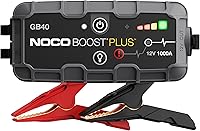
NOCO Boost GB40: roadside starting without another car
The GB40 suits drivers who want a self-contained starting option. Its spark-proof and reverse-polarity protection add safeguards, while the LED flashlight helps illuminate connection points.
NOCO claims up to 20 starts per charge. Treat that as a maximum claim, since battery condition, engine demands and temperature affect how much energy each attempt uses.
The power bank can help with a phone, but using it draws from the same portable energy reserve. Recharge the pack after use rather than assuming several remaining starts are available.
Skip this model if your engine exceeds its stated limits. Our portable jump starter buying guide explains fit, and the guide to how many amps a jump starter needs explains why peak current isn't the only selection point.
NOCO GENIUS5: charging a compatible battery at home
The GENIUS5 is the more practical charger here when you need to replenish a car battery rather than mainly maintain it. Its charging range covers compatible batteries up to 120 amp-hours.
It includes clamps, integrated eyelet terminals and a mounting bracket. Clamps suit occasional connections, while properly installed eyelets can make repeat connections easier on a vehicle you store.
Skip it for immediate roadside starting or any battery outside its supported range. A larger battery or a short charging window may call for a different charger.
NOCO GENIUS1: small batteries and long parked periods
The GENIUS1 suits a compatible motorcycle or other small battery when you can allow a longer charging window. Its charging range covers batteries up to 30 amp-hours, so check capacity as well as vehicle type.
Maintenance and recharging are different demands. Don't choose a low-current unit for a depleted, larger car battery just because you have plenty of time; confirm the intended use in the manual.
Its direct wall plug-in and 110-inch DC cable also affect placement. Check the path from outlet to battery before buying, including room to close doors or hoods without pinching cables.
How long will a battery charger take?
Charging time depends on battery capacity, charge deficit and charging current. The final stage often slows, so a simple calculation gives a rough minimum rather than a promised finish time.
For example, replacing 20 amp-hours at a steady 5 A would take 4 hours before allowing for losses and the slower finishing stage. At 1 A, the same amount would take 20 hours before those allowances.
The battery's condition and allowed charging rate also matter. More current is useful only when the battery and charger instructions permit it.
If you need the car immediately, waiting for a small charger may be impractical. Arrange starting help, then plan a proper recharge rather than assuming a short drive will restore everything.
Which tool is more useful in winter?
A jump starter handles an unexpected winter no-start, while a charger helps keep a parked battery charged before you need it. Cold reduces available battery power while making the engine harder to crank.
Short trips can leave little time to replace the energy used for starting and accessories. A compatible charger can help when the vehicle has safe access to power between drives.
Both GENIUS chargers have temperature compensation that adjusts charging for ambient conditions. That feature doesn't make a frozen or damaged battery safe to charge.
Read how cold weather affects car batteries if slow cranking appears as temperatures fall. Our cold-weather jump starter guide covers portable choices for that situation.
Keep a jump pack within its allowed storage and operating temperatures. If conditions fall outside those limits, follow the manual's guidance before use rather than trying repeated starts.
What should you check before connecting either tool?
Confirm voltage, battery chemistry and approved connection points before attaching clamps. The vehicle manual matters because some cars use remote terminals or require a specific ground point.
Read the battery label, not just the vehicle model. Lead-acid, AGM and LiFePO4 modes aren't interchangeable, and a charger supporting one lithium chemistry doesn't automatically support every lithium battery.
Turn off the ignition and accessories, secure the vehicle, and inspect the battery and cables. Don't charge or jump start a frozen, cracked, leaking or visibly damaged battery.
Work in a ventilated area away from flames and sparks, and use eye protection. Keep tools and jewelry from bridging terminals, and avoid placing equipment where belts, fans or a closing hood can catch it.
Set up a portable jump starter
Check the pack's charge and follow the exact clamp sequence in both manuals. Keep the clamps apart and connect only to the approved points.
Wait for any required ready indication, then crank only for the allowed duration. If the engine doesn't start, observe the stated rest period and attempt limit.
Once it starts, disconnect as instructed and secure all equipment before moving the vehicle. For the full process, use our portable jump starter use guide alongside the manuals.
Set up a battery charger
With AC power disconnected, select the approved connection method and attach the charger as its manual directs. Confirm the mode before charging, and keep cords clear of foot traffic and moving parts.
Use an outlet and any extension equipment suitable for the location and load. The charger, plug connections and battery need a dry, stable setup within their operating limits.
When finished, disconnect AC power before removing battery connections as directed. Never drive away with the charger or its cables attached.
Which mistakes waste time or damage equipment?
The main mistakes are choosing the wrong mode, forcing a connection and ignoring recurring faults. Automatic features reduce some risks, but they don't replace correct setup.
Both GENIUS models can begin normal charging at voltages as low as 1V and offer manual Force Mode down to 0V. Don't use Force Mode merely because the charger doesn't recognize a battery.
First confirm polarity, voltage, chemistry, battery condition and the manual's precautions. A very low reading can indicate a problem that charging won't solve.
Avoid these other common errors:
- Comparing peak starting amps with charging amps: They describe different tasks, not competing levels of overall power.
- Treating a successful start as a full recharge: The engine running doesn't show how much charge remains.
- Making repeated crank attempts: Follow the equipment's limits and investigate a no-start that persists.
- Expecting repair modes to save every battery: They cannot correct cracked cases, internal damage or every form of wear.
- Ignoring dirty or loose connections: Extra power cannot reliably overcome a poor electrical connection.
If the battery repeatedly loses charge after proper charging, arrange battery and charging-system diagnosis. Replacing equipment at random can leave the original fault unresolved.
How should you care for a jump starter and charger?
Keep the jump pack charged and within its storage limits, and inspect both tools before use. Care is mostly about readiness, clean connections and protecting cables.
Recharge the booster after a starting attempt or power-bank use. Check its charge at the intervals in its manual and before a long trip, even if it hasn't been used recently.
Store clamps so they cannot touch metal objects or damage their cables. Keep charging ports clean and dry, and stop using a pack that becomes swollen, cracked or otherwise damaged.
For a charger used through a storage season, check cable routing and connections periodically. Maintenance mode controls charging, but it doesn't detect every physical problem around the vehicle.
Can a jump starter recharge a battery or replace jumper cables?
A jump starter provides starting help, not routine battery charging. Jumper cables serve the same broad starting purpose but need a compatible donor vehicle.
Once the engine runs, its charging system may put energy back into the battery. The amount depends on driving conditions, electrical loads and battery condition, so there's no single drive length that guarantees a full recharge.
Read whether a jump starter can charge a battery for that distinction. A phone-charging port on a booster doesn't turn it into an automotive battery charger.
Cables can make sense when another vehicle is readily available and both manuals allow the procedure. Our jump starter vs jumper cables comparison explains that choice; a plug-in charger serves a separate role.
Jump starter vs battery charger: which should you choose?
Choose by where the next problem needs solving: roadside starting calls for a booster, while a parked battery needing charge calls for a charger. Buy both when you want emergency backup and have a suitable place for battery care.
Pick the GB40 if its vehicle limits fit and you'll keep it ready. Pick the GENIUS5 for compatible home charging, or the GENIUS1 for small-battery charging and suitable storage maintenance.
For broader portable choices, see our best jump starters. If home charging is your priority, use our car battery charger guide to match charging output and battery capacity.
For model instructions and troubleshooting, use NOCO battery charger support and NOCO jump starter support.
Frequently asked questions
Can a battery charger jump start a car?
The GENIUS5 and GENIUS1 cannot supply an emergency jump-start burst; they charge a battery over time. Some other chargers include a separate engine-start function, so check the model's stated functions rather than assuming every battery charger can start a vehicle immediately when its battery is weak.
Can a jump starter charge a car battery?
A jump starter provides a short burst of starting power, not a full recharge for the vehicle battery. Its USB power-bank function serves a different purpose, such as charging a phone; after a jump start, arrange suitable battery charging and investigate the cause if the battery keeps going flat.
Which is better in cold weather, a jump starter or charger?
Choose a jump starter for an unexpected no-start away from power, or a charger for battery care where you park. Cold makes starting harder and reduces available battery power, so keep the jump pack within its storage limits and never try to charge or jump start a frozen battery.
Can I leave a smart battery charger connected?
NOCO says the GENIUS5 and GENIUS1 can remain connected for ongoing maintenance of a compatible battery. Use the correct mode and follow the manual's setup and operating limits; check the battery, cables and connections periodically rather than leaving the equipment unattended for an entire storage season.
Should I buy both a jump starter and a battery charger?
Buy both if you need roadside starting backup and have an outlet for battery care at home. Start with the tool that addresses your usual problem: a portable booster for travel emergencies, or a charger for a vehicle that sits unused and needs charging or maintenance between drives.