7 Best Jump Starter (November 2026)
The best portable jump starters include the NOCO Boost GB40 for everyday car drivers, the NOCO Boost GB70 for large-engine drivers, and the Gooloo GP4000 for mixed-vehicle households.
On this page (7 sections)
- Which is the best jump starter for your vehicle?
- How do you choose a jump starter that fits your car?
- Which charging and storage details matter before buying?
- What should you do before the first roadside start?
- How do you keep a jump starter ready?
- Which mistakes leave drivers without a working solution?
- Best jump starter: which one should you choose?
The best jump starter for most cars is the NOCO Boost GB40, provided your vehicle falls within its supported engine range. It combines a compact emergency-kit design with spark-proof and reverse polarity protection.
Choose a different model when your engine needs more support, your charging windows are short or you want to power a laptop while traveling. The largest peak amp number shouldn't decide the purchase.
Start with our portable jump starter buying guide for a broader overview. If you already have a pack, our guide to using a portable jump starter explains the basic process.
Our picks at a glance
-
1

-
2

-
3

Which is the best jump starter for your vehicle?
The GB40 is the default choice for a compatible everyday car; the other picks solve more specific needs. Engine fit comes first, followed by charging equipment, storage and the devices you plan to power.
FixerFriend compared these models by their supported engines, connection protections, charging options and included accessories. Manufacturer start-count claims describe possible use under particular conditions, so they aren't a count of guaranteed roadside rescues.
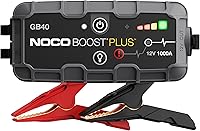
NOCO Boost GB40: Best for everyday car drivers
- 1,000 peak amps
- Up to 6.0L gas and 3.0L diesel engines
- Spark-proof and reverse polarity protection
- USB power bank
A compact emergency-kit choice for compatible everyday cars. Its engine range and connection protections cover the main needs without making fast laptop charging the focus.
Pros
- Compact emergency-kit design
- Spark-proof and reverse polarity protection
- NOCO claims up to 20 starts per charge
Cons
- Limited to smaller diesels
- Slower recharge than the fast-charging picks
The NOCO Boost GB40 suits drivers who want a dedicated emergency pack for a car rather than a larger travel power source. It supports gas engines up to 6.0L and diesels up to 3.0L, covering many everyday-car needs.
Its IP65-rated housing and rubberized covering are useful for a tool that may share a kit with other roadside gear. Keep the clamps and charging cable in the supplied bag so the pack is ready as a complete kit.
The built-in power bank can help with a low phone battery, and the flashlight helps you see connection points after dark. Reserve enough charge for starting instead of using it as your main daily phone charger.
Skip it if your engine exceeds its limits or rapid recharging is a priority. NOCO gives a 3-hour recharge time, so this is better suited to charging at home before you need it.
For a larger engine, compare the NOCO Boost GB70 review or our guide to the best jump starters for diesel trucks.
NOCO Boost GB70: Best for large-engine drivers
- 2,000 peak amps
- Up to 8.0L gas and 6.0L diesel engines
- 400-lumen flashlight
- IP65-rated housing
A step up from the GB40 for larger engines, with a brighter flashlight for work around the vehicle. Its weight and recharge time suit planned vehicle storage better than frequent carrying.
Pros
- Larger engine range than the GB40
- Spark-proof and reverse polarity protection
- NOCO claims up to 40 starts per charge
Cons
- 5 lb carry weight
- Longer recharge than the other NOCO picks
The NOCO Boost GB70 is the step up for drivers whose vehicle falls outside the GB40's engine range. It supports gas engines up to 8.0L and diesels up to 6.0L, making it the more suitable NOCO option here for many larger vehicles.
Its 400-lumen flashlight adds useful light around an engine bay or roadside kit. Spark-proof and reverse polarity protection help with connection errors, but you still need to identify the correct terminals and grounding point.
The practical tradeoffs are its 5 lb weight and NOCO's 6-hour recharge claim. Give it a secure storage spot and recharge it after use, rather than leaving that job until you're packing for another trip.
Skip it if your only vehicle fits a smaller pack and you want something easier to carry between the house and car. Extra engine coverage has little value if it makes you leave the pack behind.
Our NOCO Boost GB40 and NOCO Boost GB70 comparison helps you decide whether that step up fits your vehicle.
Gooloo GP4000: Best for mixed-vehicle households
- 4,000 peak amps
- Gooloo rates it for all gasoline engines and diesel engines up to 10.0L
- All-metal clamps
- EVA storage case
A broad-range choice for households with several compatible 12V vehicles. The included case keeps the pack and accessories together, but you'll need a suitable charging source.
Pros
- Broad engine coverage
- EVA storage case included
- Gooloo claims over 60 starts for most vehicles
Cons
- Wall charger not included
- No high-wattage USB-C charging feature
The Gooloo GP4000 makes sense for a household sharing one pack across several compatible vehicles. Gooloo rates it for all gasoline engines and diesels up to 10.0L in 12V vehicles, giving it a broad role across cars and larger equipment.
Its EVA case helps keep the smart jumper cable, charging cable and socket adapter together. The all-metal clamps and 10 built-in protection types are useful features for a pack that may move between vehicles.
Plan the charging setup before storing it: a wall charger isn't included. Its USB Type-C charging connection is rated at 5V/3A, so choose it for engine coverage rather than the high-wattage USB-C features of the travel-focused picks.
Skip it if you want an included fast charger or regularly need to recharge during brief stops. A higher peak current figure doesn't make it the better fit for those needs.
Read our Gooloo GP4000 review for more about its ports and accessories.
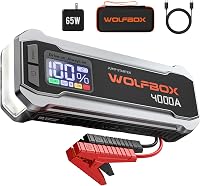
Wolfbox 4000A: Best for road-trip preparation
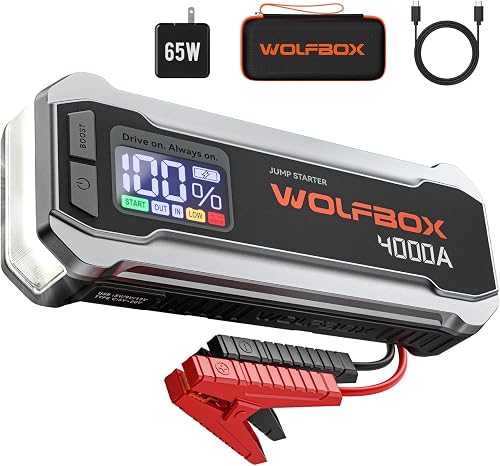
- 4,000 peak amps
- Gas and diesel engines under 10L
- 65W USB-C input and output
- PD65W charger included
An LCD status display and included fast charger make this a useful choice for checking and charging before a trip. Its USB-C port also powers compatible travel devices.
Pros
- Included PD65W charger
- LCD status display
- Two-way USB-C charging
Cons
- Use the conservative under-10L engine limit
- Lower USB-C output than the GT4000S
The Wolfbox 4000A suits drivers who want to check status and recharge before a trip with fewer charging accessories to arrange. Its LCD shows status indicators, and the included PD65W charger supports Wolfbox's claimed 1.3-hour full recharge.
Use the conservative engine limit of under 10L for both gas and diesel. If your engine sits at that boundary, select a pack whose stated range clearly includes it.
The two-way USB-C port can also power compatible travel devices. That makes it useful for an overnight stop or campsite, provided you preserve a starting reserve and recharge before the next drive.
Its one-touch boost function addresses low-voltage situations, but it isn't the first step whenever a car won't start. Check the connections and status instructions before considering that mode.
Skip it if you need more USB-C output for a compatible laptop. The GT4000S offers a higher output ceiling, while the Wolfbox is the more direct choice for an included charger and visible status.
NOCO Boost GBX45: Best for quick recharge stops

- 1,250 peak amps
- Up to 6.5L gas and 4.0L diesel engines
- 60W two-way USB-C Power Delivery
- 60-second start timer
Choose this NOCO model when short recharge windows matter more than a high claimed start count. Its USB-C port also supports compatible laptops and other devices.
Pros
- Fast USB-C PD recharge capability
- 60W input and output
- Spark-proof and reverse polarity protection
Cons
- NOCO claims up to 6 starts per charge
- Fast recharge requires suitable USB-C PD equipment
The NOCO Boost GBX45 suits drivers who can recharge often but have little time to wait. NOCO claims a 48-minute full recharge through USB-C Power Delivery, or enough energy for a start after 5 minutes of charging from depleted.
Those times depend on a suitable charging setup. A USB-C cable is included, but don't assume any phone adapter will deliver the power needed for the fastest recharge.
Its engine range reaches 6.5L gas and 4.0L diesel, and its two-way USB-C port can power compatible laptops. The 60-second start timer also makes reading the controls before an emergency worthwhile.
Skip it if you need several starts between charging opportunities. NOCO claims up to 6 starts per charge, making access to charging a more central part of the buying decision.
If your vehicle needs less engine coverage, our NOCO Boost GB20 vs NOCO Boost GB40 comparison explains the smaller alternatives.
Gooloo GT4000S: Best for laptop-carrying travelers

- 4,000 peak amps
- Up to 12.0L gas and 10.0L diesel engines
- 100W two-way USB-C charging
- 3.2-inch status screen
A travel-focused choice that combines broad engine support with high-output USB-C charging. The included car charger helps you replenish it during planned travel.
Pros
- 100W two-way USB-C charging
- Includes a 100W car charger
- Screen shows device status
Cons
- Device charging uses the emergency power reserve
- Charging temperature range is narrower than its storage range
The Gooloo GT4000S suits travelers who carry a laptop and want one pack to cover vehicle emergencies and device charging. Its 100W two-way USB-C port is the main reason to choose it over a simpler car-only pack.
Gooloo rates it for gas engines up to 12.0L and diesels up to 10.0L. The status screen helps you check the pack before leaving, while the included car charger provides a way to replenish it during travel.
Match the laptop's charging needs and cable to the port's capabilities. The available output is a ceiling, so it doesn't mean every connected device will draw that much power.
Skip it if you rarely charge devices away from an outlet and your car fits a simpler model. Powering a laptop also reduces the reserve available for starting, so keep emergency readiness ahead of convenience.
An adapter for an inflator isn't a built-in pump. If tire inflation is part of your plan, compare our best jump starters with an air compressor.
NOCO Boost GB20: Best for small-car emergency kits
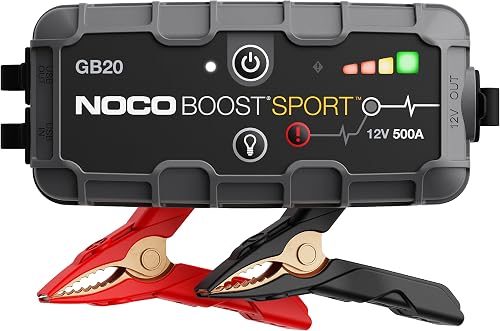
- 500 peak amps
- Up to 4.0L gas engines
- Needle-nosed booster clamps
- Spark-proof and reverse polarity protection
A focused choice for a compatible small gas vehicle rather than a shared pack for larger vehicles. Its narrow engine range makes checking fit especially important.
Pros
- Compact design
- Needle-nosed booster clamps
- NOCO claims up to 20 starts per charge
Cons
- No diesel engine rating
- Narrowest engine coverage in this group
The NOCO Boost GB20 is a focused choice for a small gas vehicle with no need to cover a larger car later. Its supported range stops at 4.0L gas engines, and it has no diesel rating.
The needle-nosed booster clamps are worth considering alongside your vehicle's connection points. Before buying, check where the approved jump points sit and whether there's room to place the clamps without forcing them.
Its compact design, flashlight and phone power-bank function suit a small emergency kit. NOCO gives a 3-hour recharge time, so build charging into your routine rather than relying on a brief top-up before leaving.
Skip it if the pack will serve a diesel, a larger gas vehicle or several vehicles with different needs. Size the purchase for the most demanding compatible vehicle it must support.
For a single small car, it remains a straightforward option. Don't choose it just because it's the smallest step in the range; choose it because its limits fit your actual use.
How do you choose a jump starter that fits your car?
Choose by vehicle voltage, fuel type and engine size, then check the practical details that affect roadside use. These picks are for compatible 12V systems, not 24V systems or a hybrid or electric vehicle's high-voltage battery.
A body style isn't enough to establish fit. Two SUVs can have different engines, batteries and jump-starting instructions, so start with the vehicle manual rather than the badge on the tailgate.
How does engine size affect the best jump starter choice?
Engine size helps narrow the range, but gas and diesel limits must be read separately. A pack's gasoline limit doesn't mean it can start a diesel of the same size.
For a shared pack, write down the requirements for every vehicle it must serve. Choose one that covers the most demanding vehicle, and keep it somewhere each driver can access.
If your engine sits near a pack's maximum range, a model with a clearly larger supported range is a sensible choice, especially for winter use. Our guide to choosing a jump starter size explains how to narrow the options.
Should you choose more peak amps?
Peak amps are a short-burst figure, not a complete measure of starting ability. They don't tell you how long current can be supplied, the pack's charge level or how it will behave with your battery.
Use supported engine ranges to establish fit, then compare the features you'll use. Choosing a larger number while ignoring charging access or awkward storage can leave you with the wrong emergency tool.
For larger vehicles, the jump starter guide for trucks and SUVs focuses on those needs. Don't assume that every pickup needs the same pack.
What changes in cold weather?
Cold weather makes starting harder while reducing the available performance of batteries. Allow more room in your choice of supported engine range, and check the pack's operating, storage and charging temperature limits separately.
A unit that can operate in freezing weather may need to warm into its permitted charging range before recharging. See our best jump starters for cold weather guide if winter reliability is your main concern.
Which charging and storage details matter before buying?
The most useful pack is one you can keep charged, store securely and reach quickly. Included charging gear and a practical storage spot often matter more than another emergency light mode.
Check the charger, cable and wall outlet plan
USB-C describes the connector, not a guaranteed charging speed. Fast recharge claims may require USB-C Power Delivery, a suitable adapter and a cable that supports the needed power.
The Wolfbox includes its fast charger, while the GT4000S includes a car charger and the GP4000 needs a separate wall charging source. Decide where you'll recharge: at home, at work or during travel.
A car charger is useful while traveling, but it isn't a recovery plan for an already depleted pack beside a disabled car. Our guide to charging a jump starter covers charging and storage routines.
Check fit with the accessories packed
Measure the intended storage space with room for the clamps and cable, not just the battery pack. A case that fits on its own may be awkward once the accessories are inside.
Store the kit where it won't slide around or press against the controls. Avoid a location that routinely becomes soaked or overheated, even when the housing has an IP protection rating.
Choose how much device charging you need
Basic phone charging can help you contact roadside assistance. Laptop charging is a separate need that calls for compatible power delivery, a suitable cable and a plan to replenish the energy used.
If the pack's main job is emergency starting, treat device charging as occasional backup. A separate daily power bank keeps your emergency reserve from being spent during an ordinary workday.
What should you do before the first roadside start?
Charge the pack, read both manuals and locate the jump points before storing it. Finding a hidden battery terminal in daylight is easier than searching for it on a dark shoulder.
Check the pack, cable and clamps for damage, and learn what its ready and fault indicators mean. Keep the instructions accessible without depending on a working phone connection.
Prepare the vehicle and check the battery
Park safely, apply the parking brake and turn off the ignition and accessories as directed. Keep the pack and cables clear of belts, fans, hot surfaces and any parts that may move when the engine starts.
Don't connect a jump starter to a battery that is frozen, leaking, cracked or swollen. Stop and seek help rather than using boost mode to push past an unsafe condition.
Confirm the approved positive connection and negative grounding point in the vehicle manual. Some vehicles use remote jump points, so the battery itself may not be where you should attach both clamps.
Connect and start according to the manuals
Follow the connection order and indicator checks in both manuals. If the pack reports a fault or won't indicate readiness, stop and check polarity, clamp contact and compatibility.
Make only the allowed starting attempts and observe the required pauses. Repeated cranking can heat the starter, cables and pack without fixing the reason the engine won't start.
After the engine starts, disconnect in the prescribed order and secure the kit. Keep your next step focused on the battery's condition rather than assuming the successful start solved the problem.
How do you keep a jump starter ready?
Keep a recharge reminder and a pre-trip charge check in your routine. A pack stored out of sight can lose charge or be put away depleted after someone uses it.
For long idle periods, Gooloo recommends charging the GP4000 every 2 to 3 months and the GT4000S at least every 3 months. Use the directions for your exact model rather than applying one brand's schedule to every pack.
Recharge after starting a vehicle or powering other devices. Before connecting the charger, let a pack that's too hot or cold return to its permitted charging temperature.
Inspect the cable insulation, connectors and clamps during charge checks. Stop using a unit with swelling, damaged wiring or other visible damage, and follow local battery disposal guidance when it needs replacing.
Keep the accessories together and tell other drivers where the pack lives. A charged unit in another household vehicle won't help the driver who expected to find it in the trunk.
Which mistakes leave drivers without a working solution?
The biggest mistakes are buying outside the supported engine range and storing the pack without checking its charge. Other errors involve using the right tool for the wrong job.
Treating boost mode as the normal start button
A low-voltage override may change how normal battery detection or safeguards work. Use it only under the exact conditions allowed by the pack's manual, after confirming the battery condition and connections.
If you don't understand why the normal mode won't engage, stop. A fault indication is a reason to investigate, not a prompt to force the next step.
Treating start-count claims as a service schedule
Claimed starts per charge don't tell you how many attempts remain after months of storage or a difficult start. Engine demand, temperature, pack charge and battery condition all affect the result.
Check the charge indicator and replenish the pack after use. Waiting until you've reached a claimed count turns a convenience figure into an unreliable maintenance plan.
Expecting a jump starter to repair a battery problem
A jump starter helps the engine crank; it doesn't repair a failing battery or charging system. A vehicle that repeatedly needs a jump needs the cause checked.
If your main problem is restoring charge between drives, compare the best car battery chargers. Choose a charger compatible with the vehicle battery and follow its instructions.
Best jump starter: which one should you choose?
Choose the best jump starter by engine fit first and recharge routine second. Start with the GB40 for a compatible everyday car, or the GB70 when you need its larger engine range.
For a shared household pack, consider the GP4000's broad engine support. Choose the Wolfbox for its included fast charger, the GBX45 for short charging windows or the GT4000S when laptop power is part of the job.
The GB20 fits a narrower role: a compatible small gas vehicle with no need to support larger engines. Before ordering any pack, confirm the connection points, charging equipment and storage space.
If you're still deciding which emergency tool to carry, our guide to jump starters vs jumper cables explains how each fits your roadside plan.
Our top 3 picks at a glance
-
1
-
2
-
3
Frequently asked questions
What is the best jump starter for most cars?
The NOCO Boost GB40 is the best jump starter for most compatible everyday cars. Choose it when your vehicle falls within its supported engine range and you want a compact emergency pack.
A larger engine, frequent laptop charging or a need for rapid recharging can justify a different model.
How many amps should a jump starter have?
Choose by supported engine size, fuel type and vehicle voltage before comparing peak amps. A larger peak number doesn't show how long a pack can supply current or whether it suits your engine.
Our guide to how many amps you need explains how to narrow the choice.
Can a portable jump starter start a diesel engine?
Yes, if the jump starter specifically supports your diesel engine size and vehicle voltage. Diesel and gasoline limits differ, even on the same pack, so don't use the gas rating as your guide.
Confirm the vehicle's jump-starting procedure and the pack's diesel limit before making any connection.
How often should you recharge a jump starter in storage?
Follow the recharge schedule for your model, and check its charge before long trips. Gooloo advises charging the GP4000 every 2 to 3 months after extended idle time and the GT4000S at least every 3 months during long-term storage.
Recharge after use rather than waiting for the next calendar reminder.
Can a jump starter charge a car battery?
A jump starter supplies a short burst for cranking; a battery charger restores charge over time. Don't treat a successful start as proof that the battery is fully charged or healthy.
Our guide on whether a jump starter can charge a battery explains which tool to use next.