Jump Starter vs Jumper Cables: Which Is Better? (November 2026)
For jump starter vs jumper cables, choose a jump starter when you need to start your car alone. Choose cables when a suitable donor vehicle is reliably available and you prefer gear that needs no charging.
On this page (11 sections)
- Jump starter vs jumper cables: what is the main difference?
- How do you choose equipment that fits your vehicle?
- Who should choose the NOCO Boost GB40?
- Who should choose the Cartman jumper cables?
- Who should choose the Energizer jumper cables?
- What should you do before connecting either option?
- Which option is easier for a first-time user?
- Which works better in cold weather?
- How should you store and care for your kit?
- What mistakes make either choice less useful?
- Jump starter vs jumper cables: which should you buy?
For jump starter vs jumper cables, choose a jump starter if you may need to start your car alone; choose cables if a suitable donor vehicle is reliably available. The pack stores power, while cables carry power from another source.
Your parking habits matter as much as your car. A quiet trailhead, a crowded garage and a driveway with a second vehicle create very different starting problems.


Jump starter vs jumper cables: what is the main difference?
A jump starter provides stored starting power, while jumper cables need a suitable external source. Both can help with a discharged starting battery, but neither repairs the reason it went flat.
A portable pack combines a rechargeable battery with clamps and starting controls. You charge it ahead of time, carry it with you and connect it according to the device and vehicle instructions.
Cables contain no stored energy. They connect the disabled vehicle to a compatible donor source, so you need another driver's help and enough space to position the vehicles.
Neither tool solves every failure to start. A faulty starter, poor connection or fuel problem can leave the engine unable to start even when electrical power is available.
The portable jump starter buying guide covers self-contained packs in more detail. For equipment that restores battery charge over time, read our comparison of jump starters vs battery chargers.
Jump starter vs jumper cables: which works when you're alone?
A charged, compatible jump starter works without a donor vehicle. That makes it the stronger choice for solo commutes, early departures and parking far from other drivers.
Cables suit households with a suitable second vehicle and drivers who can reliably arrange help. A busy parking lot alone isn't a plan, since another driver may be unable or unwilling to provide a jump.
Carrying both can make sense if space allows. Cables provide a second option if the pack is discharged, but they still depend on a suitable donor.
How do you choose equipment that fits your vehicle?
Start with system voltage, engine requirements and approved connection points. A familiar brand or a large number on the box doesn't guarantee compatibility.
Check the vehicle manual for jump-starting restrictions and the location of its designated terminals. Some vehicles use remote connection points rather than clamps placed directly on the battery.
Don't assume an electric vehicle or hybrid can serve as a donor. Follow both vehicle manuals, since their low-voltage systems and permitted procedures can differ.
For a portable pack, use the manufacturer's engine guidance alongside voltage compatibility. Diesel engines can need more starting effort than gasoline engines of similar size, especially in cold conditions.
Peak current isn't enough for a direct comparison between packs. Our guide to how many amps a jump starter needs explains why vehicle fit matters more than choosing the largest headline number.
For cables, check conductor size, material, length and clamp fit together. In the gauge system, a lower number means a thicker conductor, but gauge alone doesn't tell the whole story.
Both cable sets here use copper-clad aluminum conductors. Don't treat them as interchangeable with solid copper cables of the same gauge, particularly for demanding starts or longer runs.
Truck owners should check their engine and battery arrangement before choosing. Our guides to jump starters for trucks and SUVs and jump starting a diesel truck cover those needs.
Who should choose the NOCO Boost GB40?
Choose the NOCO Boost GB40 for independent starting power if your vehicle falls within its limits. Skip it if your vehicle exceeds those limits or you won't keep a rechargeable pack ready.
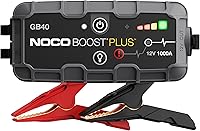
The GB40 is a 12V lithium jump starter with 1000 A peak output, rated for engines up to 6.0L gas and 3.0L diesel. NOCO claims up to 20 starts per charge, but plan around a fully charged pack rather than that maximum.
Its spark-proof and reverse polarity protection help guard against connection errors. They don't replace checking terminal markings or following the approved procedure.
A phone power bank and a 100-lumen flashlight with 7 modes add useful roadside functions. Keep enough charge in reserve for starting rather than routinely draining the pack to charge other devices.
NOCO gives a 3-hour recharge time, and the kit includes clamps, a USB-C charging cable and a microfiber bag. Charge it before putting it into service and check its charge before trips.
Who should choose the Cartman jumper cables?
Choose the Cartman set for parking situations that need extra reach. Skip it if you expect to be alone or can't confirm that the cables suit your vehicle's starting needs.
The 20 ft, 4 gauge construction gives more positioning room than the Energizer set. That can help when batteries sit on opposite sides or a donor can't park directly nose to nose.
Its covered clamps fit top- and side-post batteries. Check that the jaws can grip your vehicle's designated connection points securely, since access can be restricted by covers or nearby parts.
Extra cable length doesn't make an unsafe parking spot usable. Don't stretch cables across moving traffic or place either vehicle where another driver cannot see it.
This set also takes more effort to carry than the Energizer cables. It suits drivers who value reach enough to accept the extra bulk in their emergency kit.
Who should choose the Energizer jumper cables?
Choose the Energizer set for routine backup where donor access is dependable. Skip it if your likely parking arrangement needs more reach or your vehicle requires a different cable specification.
Its 16 ft, 6 gauge cables come with a carrying bag. Coated handles and spring clamps help with positioning, but you still need a secure connection on each approved point.
This is a useful option for a household that already has a compatible second vehicle. It can also suit drivers who prefer equipment that can stay stored without a charging reminder.
Before choosing it, picture the distance between the actual connection points on both vehicles. Bumper spacing alone can be misleading when one battery sits farther back in the engine bay.
Don't choose it solely because it's the lighter cable set here. Reach and electrical suitability come before carrying convenience.
What should you do before connecting either option?
First confirm that jump-starting is permitted and the battery is safe to approach. A damaged, leaking, swollen or frozen battery is a reason to stop and seek help.
Move away from traffic if you can do so safely, secure the vehicle and switch off unnecessary electrical loads. Keep flames, cigarettes and sparks away from the battery area.
Find the positive connection and the approved negative or ground point before opening the clamps. Don't guess from cable colors alone, and remove metal jewelry that could bridge electrical contacts.
For cables, confirm matching system voltage and that the donor vehicle is approved for the job. Position the vehicles within reach without allowing them to touch, then follow both manuals for engine state and connection order.
For a pack, check its charge and any warning indicators before connecting. Place it securely so the leads stay clear of belts, fans and other moving parts.
Our guide to how to use a portable jump starter walks through the preparation. Read the instructions while you're at home so the roadside isn't your first look at the controls.
Which option is easier for a first-time user?
A portable pack usually involves less coordination, since there's only one vehicle to prepare. Cables add another vehicle, another set of connection points and a donor procedure to follow.
Ease of setup doesn't remove the need for care. Keep disconnected clamp jaws apart, avoid reaching across moving parts and stop if a clamp won't grip securely.
Follow the equipment's limits for cranking time, rest periods and repeated attempts. Long or repeated attempts can overheat equipment and won't cure a mechanical fault.
Don't use a manual override or boost mode simply because normal operation won't begin. Such modes can bypass protections and require a specific procedure.
After the engine starts, disconnect in the instructed order and keep loose leads away from moving parts. If anything is unclear, use roadside assistance or consult the step-by-step guide to using a portable jump starter.
Which works better in cold weather?
Cold-weather success depends on a capable power source and equipment used within its limits. Cable flexibility is useful, but it doesn't measure the ability of a donor battery to start another engine.
Cartman specifies use down to -25°C/-13°F. Energizer says its cables remain flexible at -40°C; these are different claims, so they don't guarantee a direct winner for winter starting.
A portable pack also needs sufficient charge and an approved operating temperature. Don't assume its storage limit and operating limit are the same.
Never try to jump-start a battery that may be frozen. Arrange help if the battery appears damaged or its condition is uncertain.
Read about how cold weather affects car batteries before winter arrives. A weak battery deserves attention before the first cold morning leaves you relying on emergency equipment.
How should you store and care for your kit?
Keep either kit dry, secure and easy to reach, then inspect it before you need it. A tool buried beneath luggage or trapped behind an electrically operated hatch may be difficult to retrieve.
A jump starter needs charge checks at the intervals in its manual and after use. Add a calendar reminder rather than assuming it will stay ready indefinitely.
Follow its temperature limits when storing it in a vehicle. Keep it away from direct sun and heat sources, and stop using a pack with swelling, damaged leads or a damaged case.
Our guide to how long a jump starter lasts explains the care factors that affect service life. Use the device's instructions to decide when its condition calls for replacement.
For cables, inspect the full length of the insulation and the clamp connections. Exposed conductors, broken jaws or loose connections are reasons to replace the set.
Coil cables loosely, avoid pinching them under cargo and let damp equipment dry before closing its bag. Keeping gloves and a separate light nearby makes it easier to inspect connections after dark.
What mistakes make either choice less useful?
The biggest mistake is treating a successful jump as a battery repair. A vehicle that repeatedly needs help starting needs its battery, charging system or electrical connections checked.
Don't assume a short drive will fully restore a deeply discharged battery. Follow the vehicle's guidance and arrange suitable charging or service when needed.
Another mistake is buying for an imagined emergency instead of your real parking situation. Cables won't help alone in a remote lot, while a discharged pack won't provide independent power.
Don't choose cable length without checking gauge and material, or choose a pack by peak amps alone. Match the whole tool to your vehicle and the conditions where you'll use it.
Finally, don't keep trying when warning lights, heat, smoke or damage appear. Stop, move clear as appropriate and get professional help.
Jump starter vs jumper cables: which should you buy?
For jump starter vs jumper cables, make the decision around the help you can count on. Choose independent power for solo travel, or cables when a compatible donor and safe parking space are reliably available.
Pick the GB40 if it matches your vehicle and you'll maintain its charge. Choose Cartman when extra cable reach matters, or Energizer when its shorter set suits your normal parking arrangement and vehicle requirements.
Carry both if you want two routes to a start and have room, while keeping roadside assistance available for problems neither can solve. Repeated starting trouble calls for diagnosis rather than a larger emergency kit.
For more self-contained options, use our best jump starter guide. To compare cable choices for your vehicle and parking needs, see our guide to the best jumper cables.
Frequently asked questions
Is a jump starter better than jumper cables?
A jump starter is better for drivers who may need help starting a car alone. Cables suit drivers with reliable access to a compatible donor vehicle.
The right choice depends on your vehicle, likely parking position and willingness to keep a portable battery pack charged.
Can you use jumper cables without another car?
Jumper cables need a suitable external power source because they don't store energy. That source is usually another vehicle with a charged battery, but compatibility and the approved connection procedure still matter.
Don't connect cables to a random battery or power supply just because the clamps fit.
Do jumper cables or a jump starter need more maintenance?
A jump starter needs more routine attention because its internal battery must stay charged and within its storage limits. Cables need no charging, but their insulation, clamps and connections still need inspection.
Check either kit before a long trip and after use, then store it dry and secure.
Are longer jumper cables always better?
Longer cables help when vehicles can't park close together, but they also add resistance and take more room to store. Choose length alongside conductor size, material and vehicle requirements.
Buy enough reach for likely parking situations rather than choosing the longest set without checking its suitability.
Can a portable jump starter charge a car battery?
A portable jump starter supplies a short burst of starting power; it doesn't replace a charger that restores a depleted battery over time. Read our guide on whether a jump starter can charge a battery if you need to decide between emergency starting equipment and equipment for battery charging.