How Long Does a Jump Starter Last?
How long a jump starter lasts depends on battery age, storage, charging habits, and use, with no fixed replacement age for every model. Starts per charge and time between recharges are separate measures, so follow the manual and watch for declining charge retention.
On this page (9 sections)
- How long does a jump starter last before it needs replacing?
- What affects a portable jump starter's lifespan?
- How should you store a jump starter between uses?
- Which jump starter suits your vehicle and routine?
- How often should you recharge a jump starter?
- How can you avoid wasting charge during a jump start?
- Can a battery charger help a jump starter last longer?
- How can you tell if a jump starter is wearing out?
- How long should you keep your jump starter?
How long a jump starter lasts depends on battery age, storage, charging habits, and use; there is no fixed replacement age for every model. Judge readiness by its condition and charge retention, not just the date you bought it.
“Lasts” can mean years of useful life, time sitting between recharges, or starts from one charge. Those are different measures, and a high advertised start count does not promise a longer service life.
How long does a jump starter last before it needs replacing?
A jump starter needs replacement when it can no longer operate as intended and the manufacturer's troubleshooting steps do not resolve the problem. Age alone is not enough to make that decision.
Rechargeable batteries lose capacity as they age, even with light use. Heat, prolonged storage while discharged, and repeated use can add to that loss.
A pack may still show a full charge while delivering less starting power than before. Its charge display helps you track readiness, but it cannot confirm the battery's full health.
Treat the warranty as a coverage period, not a replacement schedule. NOCO backs the Boost GB40 and Boost GB70 with 1-year limited warranties; neither term establishes their total useful life.
How long does a jump starter last on one charge?
Starts per charge and storage time measure different things. Cranking uses power in short bursts, while a stored pack gradually loses charge without starting an engine.
NOCO claims up to 20 starts per charge for the GB40 and up to 40 for the GB70. Actual results depend on the engine, vehicle battery condition, temperature, and length of each attempt.
Do not plan around getting the maximum count before recharging. Check the charge after use, including phone charging or flashlight use, and follow the manual's recharge instructions.
What affects a portable jump starter's lifespan?
Heat exposure, charge management, and physical damage are the main care issues you can control. Buying a larger unit does not remove those needs.
- Heat: A closed vehicle can become much hotter than the air outside, so check the permitted storage range before leaving a pack inside.
- Low charge: Long storage while discharged can harm a rechargeable battery and leave you without enough power for an emergency.
- Heavy use: Repeated or lengthy cranking attempts draw down the pack and can heat it.
- Damage: Crushed housings, loose ports, and damaged clamp cables can make a unit unsafe or unreliable.
- Other power use: Charging devices consumes energy you may later need for starting.
Cold can reduce available power without proving permanent battery damage. Keep storage, operating, and charging limits separate: a temperature allowed for storage may not be allowed for charging.
How should you store a jump starter between uses?
Store it dry, secured, and within its manual's temperature range, at the recommended charge level. Choose a place you can reach without unpacking the whole vehicle.
Keep clamps and cables arranged so they cannot snag, get crushed, or contact metal objects. Store the correct charging cable with the unit so a needed recharge does not become a search for accessories.
Set a reminder based on the manual's charge-check interval. Also inspect it before a long trip and after a season of storage, looking for swelling, cracks, cable damage, or moisture.
Do not assume a glove box is suitable throughout the year. If your vehicle regularly exceeds the storage limits, choose a more suitable location and make bringing the pack part of your departure routine.
Which jump starter suits your vehicle and routine?
Choose engine compatibility first, then consider carrying weight and recharge time. Peak amps alone do not tell you how long a pack will last or whether it fits your vehicle.
Check your vehicle's battery voltage, fuel type, and engine size before comparing models. If you are unsure which features matter, start with how to choose a jump starter.
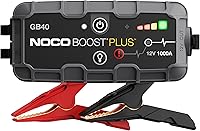
NOCO Boost GB40: for a compact emergency kit
The GB40 suits drivers who want a compact backup for a compatible 12V vehicle. It has 1000 A peak output and is rated for engines up to 6.0L gas or 3.0L diesel.
Its spark-proof connections and reverse-polarity protection help guard against connection errors. You still need to identify the correct terminals and follow both the vehicle and jump starter instructions.
Skip it if your engine exceeds its stated limits. Also reconsider this size if your main need is frequent starts across several larger vehicles rather than occasional emergency backup.
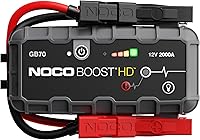
NOCO Boost GB70: for larger compatible engines
The GB70 suits drivers whose engines exceed the smaller model's limits. It provides 2000 A peak output and supports engines up to 8.0L gas or 6.0L diesel.
At 5 lb, it adds more weight to your kit. That tradeoff makes sense when you need its engine coverage, but a smaller compatible pack may be easier to carry between vehicles.
Skip it if you want the lightest practical backup and your vehicle fits a smaller model. Its larger advertised start count is not evidence that its internal battery will last more years.
How often should you recharge a jump starter?
Follow your model's recharge schedule and check it after use. There is no single interval that suits every portable pack.
NOCO gives recharge times of 3 hours for the GB40 and 6 hours for the GB70. These describe recharge time, not how long either unit can sit unused or how many years it will remain useful.
Use the specified charging connection and suitable power source. Follow the allowed charging temperature range, especially after the pack has spent time in a freezing vehicle or hot trunk.
Before storing it again, confirm that charging completed as directed. If it will not charge normally, check the approved cable, power source, and error indicators before assuming the battery has failed.
Read how to charge a jump starter for charging steps. For the difference between stored energy and starting current, see how a jump starter works.
How can you avoid wasting charge during a jump start?
Prepare the connections before cranking and follow the permitted attempt length and rest period. Repeated attempts with poor connections waste charge without solving the cause.
- Park safely, switch off the ignition, and turn off unnecessary electrical loads.
- Check the vehicle battery for visible damage or freezing; do not jump a damaged or frozen battery.
- Confirm that the pack has enough charge and matches the vehicle's battery system.
- Connect it in the order and at the points specified by the vehicle and jump starter manuals.
- Follow the instructions for starting, pauses between attempts, and disconnection.
If the engine will not start after the allowed attempts, stop and investigate. A fuel, starter, or other mechanical problem will not be solved by draining the jump pack.
Do not use a manual override simply to bypass an unexplained error. Our guide to using a portable jump starter covers setup and connection basics.
Can a battery charger help a jump starter last longer?
A vehicle battery charger cannot maintain the jump starter's internal battery. It can help maintain a compatible vehicle battery, which may reduce avoidable calls on your emergency pack.
The NOCO GENIUS1 is a 1 A charger and maintainer for compatible 6V and 12V lead-acid and LiFePO4 batteries. It suits supported batteries in vehicles that sit unused near an electrical outlet.
Check battery capacity and chemistry before choosing it: NOCO specifies charging batteries up to 30 Ah. Its low output favors small-battery charging and maintenance rather than quickly replenishing a depleted large vehicle battery.
Skip it if you need an immediate roadside start or have no outlet available. NOCO supports ongoing maintenance when connected as directed, but you must select the correct mode for the battery.
The guide to jump starters vs battery chargers explains which tool fits each task.
How can you tell if a jump starter is wearing out?
Faster charge loss or repeated starting failure deserves attention, especially if the pack previously handled the same compatible vehicle. First rule out charging, clamp contact, and vehicle battery problems.
Keep a brief record of recharge dates and unexpected charge drops. This can reveal a change without deliberately draining the pack or making unnecessary starting attempts.
Stop using a swollen, cracked, leaking, or unusually hot unit. Do not open the battery housing; contact the manufacturer and use an approved local battery disposal service if replacement is needed.
Frequent vehicle breakdowns need a separate diagnosis. Have the vehicle battery and charging system checked rather than using repeated jumps as routine care.
How long should you keep your jump starter?
Keep it while it remains safe, holds charge normally, and works as directed. How long a jump starter lasts should guide your care routine, not create an arbitrary replacement date.
Choose the GB40 for a compact kit within its engine limits, or the GB70 when you need its larger engine coverage. Choose the GENIUS1 for compatible vehicle battery maintenance near an outlet.
Before replacing an otherwise suitable pack with a larger one, read how many amps you need for a jump starter. Use our portable jump starter buying guide to compare the remaining features.
Frequently asked questions
How many years does a portable jump starter last?
There is no fixed number of years that applies to every portable jump starter. Battery age, heat exposure, charging habits, and use affect its useful life, so assess its condition and charge retention rather than replacing it by age alone.
Follow the manual and seek manufacturer advice if performance changes.
How often should I recharge a jump starter?
Use the recharge schedule in your model's manual rather than a universal monthly rule. Check its charge before a long trip and after a jump start, phone charge, or other use.
Recharge as directed, and avoid leaving the pack discharged or charging it outside its allowed temperature range.
Can cold weather shorten a jump starter's life?
Cold can temporarily reduce available power, so weak performance in freezing weather does not by itself mean the battery has reached the end of its life. Follow the unit's storage, operating, and charging temperature limits.
Let it reach an allowed charging temperature naturally before plugging it in.
How do I know when to replace a jump starter?
Replace it when it can no longer operate as intended and the manufacturer's troubleshooting steps do not resolve the problem. Stop using a swollen, cracked, leaking, or unusually hot pack immediately.
Damaged clamps or charging equipment can cause similar symptoms, so seek manufacturer advice before deciding the internal battery has failed.