NOCO Boost GB20 vs GB40: Which Is Better? (November 2026)
For NOCO GB20 vs GB40, choose the GB20 for one smaller gasoline vehicle or the GB40 for larger gas engines, compatible diesels or a shared household pack. Confirm engine coverage and your vehicle's jump-start procedure before buying.
On this page (10 sections)
- NOCO GB20 vs GB40: which one fits your vehicle?
- What does the GB40's extra starting output mean?
- Which shared features should influence your choice?
- Will either pack fit your emergency kit?
- What should you do before the first roadside use?
- How should you use either NOCO pack safely?
- Which mistakes leave drivers needing another jump?
- How do you keep the pack ready between uses?
- When should you consider the Gooloo GP4000 instead?
- NOCO GB20 vs GB40: make the final choice
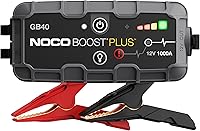
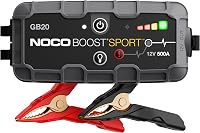
For NOCO GB20 vs GB40, choose the GB20 for a smaller gasoline vehicle or the GB40 for broader engine coverage. The GB20 covers gas engines up to 4.0L; the GB40 covers gas engines up to 6.0L and diesel engines up to 3.0L.
The GB40 is the stronger default for a household sharing one pack across compatible vehicles. The GB20 makes sense for a dedicated small-car emergency kit when you have no need for that wider range.

NOCO GB20 vs GB40: which one fits your vehicle?
Match fuel type, engine size and electrical system before comparing extras. Both models are 12V lithium jump starters, so neither is a general solution for every vehicle carrying a car, truck or RV label.
Find your engine displacement in the vehicle manual or vehicle information, rather than guessing from the body size. A compact diesel and a large gasoline SUV can need different choices even when both use a conventional starting battery.
Also check where the vehicle allows a jump starter to connect. Some vehicles have designated jump points away from the battery, which matters when planning clamp access.
For a broader way to match a pack to your vehicle, see our guide to what size jump starter you need. Make a short list of every vehicle the pack must serve before choosing.
NOCO GB20 vs GB40 for one small gasoline car
Choose the GB20 when its engine range covers the only vehicle you need to support. A dedicated pack for a small gasoline commuter does not need diesel coverage just because another model offers it.
That choice is clearest when your driving needs are stable. You know the vehicle, know its connection points and intend to keep the pack with that car.
Choose the GB40 instead if you expect the same pack to serve another compatible vehicle. Its broader range is useful when a household owns different engine sizes or may replace a small car with something larger.
Don't buy the GB20 expecting it to occupy less space. The stated dimensions match, so narrower engine coverage does not bring a smaller footprint here.
When the GB40's diesel coverage matters
Choose the GB40 over the GB20 for a diesel within its supported range. A gasoline rating is not permission to use the smaller pack on a diesel of similar displacement.
Skip both models if your engine exceeds their supported ranges. Neither a familiar brand nor an impressive peak-current number removes that limit.
Our guide to jump starting a diesel truck explains the preparation involved. Confirm the vehicle's electrical setup before assuming that a portable 12V pack fits the job.
What does the GB40's extra starting output mean?
The GB40's 1000 peak amps support broader engine coverage than the GB20's 500 peak amps. That makes it the more flexible option here, but it does not promise a successful start in every condition.
Peak current is a short-duration output figure, not the amount of energy stored in the pack. Doubling that figure does not mean double the number of starts or double the useful life.
NOCO claims up to 20 starts per charge for each model. Treat that as a best-case planning figure, since engine demand, battery condition, temperature and the pack's charge level affect what happens during a jump.
For an emergency kit, recharge after use instead of counting down toward that number. Several difficult attempts can draw down a pack differently from a series of easy starts.
Cold conditions also make generous starting capacity more useful because engines can be harder to crank and batteries deliver less available power. Even then, a larger pack cannot fix a damaged battery or a mechanical fault.
Which shared features should influence your choice?
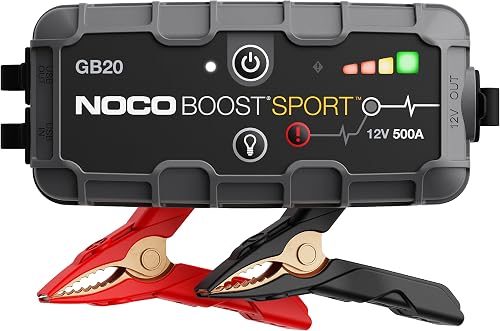
The shared features are useful roadside tools, but they do not favor either NOCO model. Both include a power bank, a 100-lumen flashlight with 7 modes, and spark-proof and reverse-polarity protection.
The flashlight includes SOS and strobe modes. It can help you see a connection point, although keeping a separate light available leaves both hands free for the clamps.
The power bank can supply emergency energy to phones and tablets. If starting the vehicle is the priority, avoid using the pack as your everyday device charger between charge checks.
Both have IP65-rated housings with rubberized over-molding. Water resistance does not make a pack suitable for submersion, and wet or dirty connectors still need attention before storage.
Each includes clamps, a USB-C charging cable and a microfiber storage bag. NOCO gives both a 3-hour recharge time and backs each with a 1-year limited warranty.
Those similarities leave little reason to choose by accessory count. For more detail on the broader-coverage model, read our NOCO GB40 review.
Will either pack fit your emergency kit?
Plan for the pack, clamps and cable together, rather than measuring only the main unit. Both NOCO models have stated dimensions of 4.61 x 8.19 x 4.21 inches.
Measure your intended storage spot before ordering, especially if you want to use a glove box or a narrow compartment. Leave enough room to put the kit away without sharply bending cables or forcing the clamps against the pack.
The supplied weight figures conflict, so there is no sound basis here for choosing on a small weight difference. Storage access and engine coverage are more useful deciding factors.
Keep the kit secured where it will not slide under a seat or become loose cargo. It should also be reachable without unloading a full trunk beside a road.
If you share one pack between vehicles, give it a regular home and a clear transfer routine. A compatible jump starter left in the other car cannot help when you need it.
What should you do before the first roadside use?
Charge the pack, read both manuals and locate your vehicle's approved connection points before an emergency. Preparation at home is easier than learning the controls beside traffic.
Use this short setup checklist:
- Confirm compatibility. Check engine size, fuel type, system voltage and any vehicle-specific restrictions.
- Charge as directed. Use a power source that meets the jump starter manual's requirements.
- Find the connection points. Identify the positive point and the approved negative or ground point in the vehicle manual.
- Inspect access. Check that the clamps can reach and grip without stretching cables or resting near moving parts.
- Learn the indicators. Know what normal readiness and fault signals mean before connecting anything.
- Store the kit together. Keep the charging cable, clamps and instructions with the pack.
A USB-C cable alone does not tell you which wall adapter or charging method to use. Our guide to charging a jump starter explains the routine to build around the device instructions.
Check the charge again before a long trip. A pack put away after a jump or a phone recharge may have less reserve than you remember.
How should you use either NOCO pack safely?
Follow the vehicle manual and the instructions supplied with your exact pack. Connection protections help reduce certain mistakes, but they do not make every battery or roadside location safe.
First, choose a safe place to work and switch off unnecessary electrical loads. If traffic, poor visibility or an unsafe stopping position prevents safe access, arrange roadside help.
Do not attempt to jump a battery that is frozen, cracked, swollen or leaking. Stop if you notice smoke, unusual heat or signs of serious damage.
Use only the approved connection points and follow the required connection order. Position the pack and cables clear of belts, fans and other moving parts.
Once connected, check the device's status before attempting to start. A fault indication calls for checking the instructions and connections, not repeatedly trying the ignition.
Keep cranking attempts and pauses within the limits in both manuals. If the engine does not start after the permitted attempts, stop and investigate rather than draining the pack through repeated cranking.
After a successful start, disconnect in the specified order and secure the kit. Our portable jump starter use guide covers the general process, while your manuals provide the exact steps.
Which mistakes leave drivers needing another jump?
Repeated jumping without finding the cause is the biggest mistake. A jump starter supplies short starting assistance; it does not restore a worn battery or repair a charging fault.
Leaving lights on once is different from needing help every few mornings. Recurring trouble calls for a battery and charging-system check, along with an investigation of anything draining the battery while parked.
Don't assume that a short drive fully restores a deeply discharged battery. Depending on its condition, it may need a suitable battery charger and further inspection.
Poor clamp contact is another avoidable problem. A clamp gripping corrosion, paint or an unsuitable point may prevent useful current flow even when the pack has charge.
Also avoid guessing at warning lights or treating an override control as the normal next step. Any mode that bypasses automatic checks requires the exact manual procedure and a clear understanding of the battery's condition.
Finally, do not select by vehicle label alone. “Truck,” “boat” and “RV” describe broad groups, while engine size, fuel type and electrical setup decide whether the pack belongs in that application.
How do you keep the pack ready between uses?
Check its charge regularly, recharge after use and follow the storage limits in its manual. A jump starter is useful only when the battery inside it has enough energy available.
Set a recurring reminder instead of relying on memory. Include a charge check before seasonal storage, a long trip or a period when the vehicle will sit unused.
Keep the pack away from direct sun and avoid storage conditions outside its allowed temperature range. Vehicle interiors can become much hotter than the outside air.
Before putting the kit away, check the housing, clamps and cables for damage. Keep connectors clean and dry, and prevent the clamp jaws from contacting loose metal objects.
Do not continue using a pack with swelling, damaged wiring or unusual heat. Follow the manufacturer's guidance for service or disposal rather than putting it back into the emergency kit.
When should you consider the Gooloo GP4000 instead?
Consider the GP4000 when your compatible vehicle exceeds the two NOCO models' engine coverage. GOOLOO rates it for all gasoline engines and diesel engines up to 10.0L, giving it a different role from the small-car GB20.
It has 4000 peak amps, USB charging ports and an included EVA storage case. At 3.9 lb, it also adds weight to the kit, and a wall charger is not included.
That broader rating matters more than simply winning an amps comparison. If your only vehicle is already covered by a NOCO model, choose around your actual needs rather than the largest number.
GOOLOO advises charging the GP4000 every 2–3 months during extended idle periods. Treat maintenance instructions as part of the buying decision, especially for a pack that may spend months unused.
For a wider brand comparison, see NOCO vs Gooloo. Our best jump starter guide can help if neither NOCO fits your vehicle or preferred emergency kit.
NOCO GB20 vs GB40: make the final choice
Buy for the largest compatible engine the pack must serve, then build a charging routine around it. That rule settles the NOCO GB20 vs GB40 decision more clearly than their shared lights, power banks or storage dimensions.
Choose the GB20 for a dedicated smaller gasoline vehicle with no need to cover a diesel or a larger engine. Choose the GB40 for a broader household role, provided every vehicle remains within its supported range.
Skip both if your engine or electrical system falls outside their coverage. For another NOCO option, use our NOCO GB40 vs GB70 comparison to check the next model against your vehicle's requirements.
Frequently asked questions
What is the main difference between the NOCO GB20 and GB40?
Engine coverage is the main difference: the GB20 is rated for gasoline engines up to 4.0L, while the GB40 covers gasoline up to 6.0L and diesel up to 3.0L. Choose around fuel type and engine size first, since their shared accessories and stated dimensions do little to separate them.
Can the NOCO GB20 jump-start a diesel?
Choose a diesel-rated pack instead of the GB20, which has a gasoline engine rating. The GB40 covers diesel engines up to 3.0L, so it suits only diesels within that range.
Check your engine's displacement, electrical system and approved jump-start points before deciding which pack belongs in your vehicle.
Are the NOCO GB20 and GB40 the same size?
Both have stated dimensions of 4.61 x 8.19 x 4.21 inches, so the GB20 does not offer a smaller footprint on those figures. Measure the space available in your vehicle and allow room for the clamps and cable.
Choose between them mainly by engine coverage rather than expected storage savings.
Do the GB20 and GB40 include a flashlight and power bank?
Yes, both include a power bank and a 100-lumen LED flashlight with 7 modes, including SOS and strobe. These features can help during a roadside stop, but using the pack for other devices spends stored energy.
Recharge it after use so emergency starting remains its main job.
Does the GB40 charge a weak car battery?
The GB40 provides starting assistance rather than a full battery recharge. A vehicle that needs repeated jumps may have a worn battery, a charging-system fault or a drain while parked.
Arrange a battery and charging-system check instead of treating successful starts as proof that the underlying problem has gone away.