What Size Jump Starter Do I Need?
To work out what size jump starter you need, match your vehicle’s voltage, engine displacement and fuel type. Choose extra capacity for larger vehicles you also drive, then check charging, storage and cold-weather limits.
On this page (9 sections)
- What size jump starter do I need for my engine?
- How do peak amps relate to engine size?
- Which jump starter size fits your vehicle?
- Should you choose a larger jump starter than you need?
- Does cold weather change the size you need?
- What should you check before the first use?
- How do you keep the right-size starter ready?
- Which sizing and use mistakes should you avoid?
- What size jump starter do you need? Make the final choice
The jump starter size you need depends on vehicle voltage, engine displacement and fuel type. Match those first, then choose extra capacity for other vehicles, difficult starting conditions or repeated use.
A compact gas car and a diesel pickup can need very different starters, even if both use a 12V battery system. The biggest amp number is not a substitute for the correct engine rating.
If you want a broader overview of formats and features, see our portable jump starter buying guide.
What size jump starter do I need for my engine?
Choose a starter whose gas or diesel engine limit covers your engine’s displacement, with the correct voltage for your vehicle. If your engine falls between two models’ limits, move up to the one that covers it.
Find displacement in your owner’s manual or the vehicle manufacturer’s specifications. Use the exact engine fitted to your car, since the same model can come with several engines.
How to work out what size jump starter you need
Write down system voltage, displacement and fuel type before comparing products. This short checklist rules out unsuitable starters faster than sorting by peak amps.
- Confirm voltage. The four starters below are for 12V systems.
- Find engine displacement. Look for a figure in liters, such as 2.0L or 5.7L.
- Confirm gas or diesel. A gas limit does not guarantee diesel suitability.
- Check your other vehicles. Compare the largest gas and largest diesel engine separately.
- Choose within the stated limits. Leave room for another vehicle only if you expect to need it.
Body style is a poor shortcut. A crossover may have a smaller engine than a sedan, and a pickup’s badge does not tell you its displacement or electrical system.
For example, a 3.5L gas engine fits a starter rated for up to 4.0L gas. A 3.5L diesel needs a suitable diesel rating, even though the displacement number is identical.
How do peak amps relate to engine size?
Peak amps describe a brief maximum output, rather than sustained cranking performance. Use the engine limit to establish fit, then use output figures alongside the other features.
These four NOCO models provide clear steps in engine coverage:
| Model | Peak output | Gas engine rating | Diesel engine rating |
|---|---|---|---|
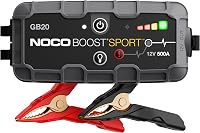
| NOCO Boost GB20 | 500 A | Up to 4.0L | No diesel rating provided |
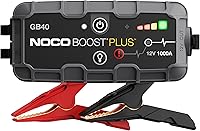
| NOCO Boost GB40 | 1,000 A | Up to 6.0L | Up to 3.0L |
| NOCO Boost GBX45 | 1,250 A | Up to 6.5L | Up to 4.0L |
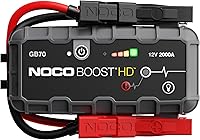
| NOCO Boost GB70 | 2,000 A | Up to 8.0L | Up to 6.0L |
A peak figure does not describe how long a starter can maintain that output. It also does not account for your battery’s condition, the starter’s charge level or the temperature during use.
Do not directly match a vehicle battery’s cold cranking amps, or CCA, to a jump starter’s peak amps. They describe different measures, so equal-looking numbers do not guarantee equal starting ability.
Battery capacity is another separate figure. Milliamp-hours describe stored charge under stated conditions, not the current a starter can deliver to an engine.
For more help separating these numbers, read how many amps you need for a jump starter.
Which jump starter size fits your vehicle?
Choose the smallest model that covers your actual needs, or step up for a specific reason such as a second vehicle or faster recharging. These examples show where each option makes sense.
All four include spark-proof and reverse polarity protection. Those features help with connection errors, but you still need to identify the correct terminals and follow both manuals.
NOCO Boost GB20: for a smaller gas car
The GB20 suits a driver keeping one smaller gas vehicle ready for an occasional flat battery. It makes sense when you have no diesel vehicle to cover and no larger engine planned.
NOCO claims up to 20 starts per charge and a 3-hour recharge. For occasional emergency use, the practical habit is to recharge after use rather than save that task until the pack runs low.
Its 100-lumen flashlight has 7 modes, including SOS and strobe, and its power bank can supply emergency power to a phone. Those features support a roadside kit without requiring a separate light for every task.
Skip it for a diesel or a gas engine above its limit. Also consider a larger model if this starter will move between a small car and a larger family vehicle.
NOCO Boost GB40: for mixed car and light-truck needs
The GB40 suits households that need broader engine coverage than the GB20 provides. It is a useful middle choice when your vehicles fit its limits and rapid recharging is not a priority.
NOCO claims up to 20 starts per charge and a 3-hour recharge for this model. The engine coverage is the reason to step up from the GB20, rather than expecting a higher advertised number of starts.
Choose it for a compatible gas SUV, car or light truck, or a smaller diesel. Check each vehicle separately if the starter will serve more than one driver.
Skip it when your diesel exceeds its limit, or when the GBX45’s charging features better match your routine. For diesel connection details, see our guide to jump starting a diesel truck.
NOCO Boost GBX45: for drivers who value fast recharging
The GBX45 suits drivers who need its broader engine coverage or want a faster USB-C charging routine. Its main distinction is how it takes in and supplies power.
Its 60-watt USB-C Power Delivery port handles both input and output, including power for compatible laptops. NOCO claims a full recharge in 48 minutes, or enough charge for a jump start in 5 minutes.
Plan around those times only with a suitable charging setup. Check the required power adapter and cable before buying, since the included USB-C cable alone does not guarantee the charger’s output.
NOCO claims up to 6 starts per charge, and the unit has a 60-second output timer. Read the timer instructions before an emergency so you know how to proceed if the engine does not start promptly.
Skip it if your engine exceeds its limits or frequent starts between charges matter more than fast recharging. A larger peak figure does not mean this model stores enough energy for more starts than every smaller model.
NOCO Boost GB70: for larger engines and shared emergency kits
The GB70 suits larger compatible engines and drivers who want one starter for a wider group of vehicles. It is the broadest engine match among these four options.
NOCO claims up to 40 starts per charge and a 6-hour recharge. Its 400-lumen flashlight also provides more stated light output than the other models here.
The pack weighs 5 lb, so decide where it will stay before buying. A secure vehicle emergency kit is a more practical home for it than a small bag you carry every day.
Skip it if your only vehicle fits a smaller model and carrying weight matters more than broader coverage. It also remains unsuitable for engines or electrical systems outside its stated limits.
Should you choose a larger jump starter than you need?
Size up for a clear use, such as another vehicle, an engine near a model’s upper limit or regular help for family members. Buying the largest pack without a plan can add weight and charging demands.
A driver with one small gas car has different needs from a household sharing a starter between a car and a diesel SUV. For the household, covering both engines can justify the larger unit.
Choosing some headroom is reasonable if you often face difficult starts. It gives you a broader engine rating, but it does not turn the pack into a repair for a failing battery.
A compatible higher-output starter does not force its maximum advertised current through the vehicle. The starter motor draws current according to the starting load, so correct voltage and proper connections remain essential.
Before moving up, measure the storage space and think about access. A starter buried under luggage is harder to use when the battery fails in a crowded parking space.
Does cold weather change the size you need?
Cold weather favors preparation and some output headroom, but a larger pack still needs to be charged and within its operating limits. Cold can reduce battery performance while making the engine harder to turn.
If winter starts are your main concern, check operating, charging and storage temperatures before choosing. These are separate limits, and permission to use a pack at one temperature does not automatically mean you can charge it there.
Do not deliberately heat a lithium starter with a heater, flame or hot water. Follow its instructions for bringing it within the permitted temperature range.
Cold also affects the vehicle battery itself. Our guide to how cold weather drains a car battery explains why a marginal battery may fail when temperatures fall.
If slow cranking becomes a pattern, arrange a battery and charging-system check. Repeatedly reaching for a bigger starter can hide the underlying problem without solving it.
What should you check before the first use?
Charge the pack, find the vehicle’s approved jump points and read the starting procedure before you need it. A correctly sized starter still needs a sound connection and a suitable battery condition.
Some vehicles use remote jump terminals rather than direct access to the battery. Locate them while you have daylight and time, especially if the battery sits under a seat or behind trim.
With everything switched off, check that the clamps can reach the designated connection points without stretching. They should grip firmly without touching each other or nearby metal parts.
Before connecting:
- Make the area safe. Park securely, apply the parking brake and switch off accessories.
- Inspect the battery. Do not attempt a jump on a frozen, leaking, swollen or visibly damaged battery.
- Check the starter. Stop if its housing, cables or clamps are damaged.
- Identify polarity. Use terminal markings and the vehicle manual, not cable color alone.
- Keep clear of moving parts. Route cables away from belts and fans.
Follow the exact connection sequence in both manuals. Use the vehicle’s designated ground point where required, and place the pack where it cannot fall or shift into moving components.
Use only the permitted cranking time and pause between attempts as instructed. After the engine starts, disconnect in the required order and keep loose clamps away from metal.
For a fuller walkthrough, read how to use a portable jump starter.
How do you keep the right-size starter ready?
Recharge after use and check charge at the interval in the manual. Do not assume a pack will remain ready indefinitely because it has been sitting unused.
Keep its cable with the starter and identify a compatible charger at home. A charging routine is easier to maintain when you do not have to search for the right accessories.
Store the pack within its temperature limits, secured against movement and away from moisture. A vehicle cabin can become much hotter than the outdoor air, so choose the storage location with seasonal conditions in mind.
Treat power-bank use as a draw on your emergency reserve. If you use the pack for a phone or laptop, check its charge again before a long drive.
NOCO’s maximum starts-per-charge claims are not a countdown you should rely on. Engine size, conditions and the length of each attempt affect how much energy a start uses.
Our guide to how to charge a jump starter covers the charging habits to establish before putting one in your emergency kit.
Which sizing and use mistakes should you avoid?
Avoid choosing by amps alone, confusing fuel ratings or using repeated jump starts as battery care. These mistakes can leave you with the wrong tool even when the pack looks powerful enough.
Using a gas rating for a diesel
A diesel must fit the starter’s diesel engine limit. Do not borrow the larger gas figure or assume a smaller diesel will be covered by a gas-only rating.
Check unusual electrical setups with equal care. Two batteries do not by themselves tell you the system voltage or the correct connection method.
Assuming a jump starter recharges the car battery
A jump starter provides a brief burst of starting power. It is not a replacement for charging a depleted vehicle battery with an appropriate charger.
After a successful start, address the cause of the discharge and follow suitable battery recovery advice. Read whether a jump starter can charge a battery before treating the pack as a charger.
Forcing another attempt after an error
An error light is a reason to stop and check the instructions. Repeatedly cranking can drain the pack and heat the starter motor without addressing poor contact or another fault.
Do not treat any manual override as a normal boost setting. If your unit has one, follow its specific instructions because it may bypass protections used during normal operation.
Expecting more amps to fix every no-start
A starter cannot solve missing fuel, an immobilizer fault or a failed starter motor. If the engine turns at normal speed but will not run, more jump-starting output may not help.
Stop after the permitted attempts rather than moving straight to a larger pack. The next step may be roadside help or diagnosis.
What size jump starter do you need? Make the final choice
Choose the GB20 for a smaller gas vehicle, the GB40 for broader everyday engine coverage, the GBX45 for its charging features, or the GB70 for larger compatible engines. Use the table to confirm your exact engine before deciding.
For several vehicles, choose around the largest gas and diesel engines separately. For winter use, add reasonable headroom and verify temperature limits rather than relying on peak amps alone.
Before ordering, settle 3 practical details: where the pack will live, how you will recharge it and where its clamps connect. Those answers help turn the right size into a kit you can use promptly.
For the remaining shopping decisions, see how to choose a jump starter.
Frequently asked questions
What size jump starter do I need for a regular car?
Choose a jump starter that matches your car’s voltage and covers its gas or diesel engine displacement. A small gas car may fit the GB20’s engine limit, while a larger engine may need another model.
Use the engine details in your vehicle manual, rather than choosing by body style alone.
Is a higher amp jump starter always better?
Higher peak amps do not automatically make a jump starter the better choice. Match voltage and the stated engine limit first, then consider charging speed, storage space and other vehicles you drive.
A larger compatible unit can be useful, but it cannot fix a damaged battery or an unrelated starting fault.
What size jump starter do I need for a diesel truck?
Choose by the truck’s diesel displacement and electrical system, not its gas engine equivalent. The GB40 covers up to 3.0L diesel, the GBX45 up to 4.0L and the GB70 up to 6.0L.
If your truck exceeds those limits or uses a different system voltage, choose another compatible starter.
Should I size up for cold weather?
Extra capacity can provide useful headroom, but temperature limits and charge level still matter. Choose a compatible starter rated above your engine size if you want that margin, then follow its cold-weather instructions.
Do not assume a larger amp number permits charging or use outside the manufacturer’s temperature limits.
Can one jump starter work for several vehicles?
Yes, if its voltage and separate gas and diesel engine limits cover every vehicle you want to start. Check the largest engine of each fuel type and confirm the connection procedure for each vehicle.
Keep the starter somewhere accessible, and recharge after use rather than relying on the advertised maximum number of starts.