NOCO GB40 vs GB70: Which Is Better? (November 2026)
In the NOCO GB40 vs GB70 choice, pick the GB40 for a lighter car emergency kit or the GB70 for larger engines. Match your engine size and fuel type first, then decide how much weight and charging time you can accept.
On this page (11 sections)
- NOCO GB40 vs GB70: what is the main difference?
- Which NOCO jump starter fits your engine?
- Who should buy the GB40, and who should skip it?
- Who should buy the GB70, and who should skip it?
- Which one is easier to keep in the car?
- How should you set up the jump starter before an emergency?
- Do the GB40 and GB70 offer the same safety features?
- How should you charge and care for either model?
- Should you consider the NOCO GBX45 instead?
- What common mistakes should you avoid?
- How should you make the final NOCO GB40 vs GB70 choice?
Choose the GB40 for a lighter emergency kit and the GB70 for larger engines in the NOCO GB40 vs GB70 decision. Your engine size and fuel type should settle the first part of the choice.
If both fit your vehicle, choose around how you'll store, carry and recharge the unit. Extra output can help cover a wider range of vehicles, but it also means carrying a larger pack.
FixerFriend compared the engine limits, charging features and storage needs to show where each model makes sense.


NOCO GB40 vs GB70: what is the main difference?
The GB70 covers larger engines, while the GB40 is easier to carry and takes less time to recharge. Start with the engine limits below before comparing the extra features.
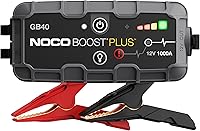
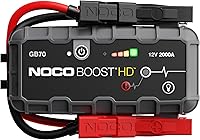
| Feature | NOCO Boost GB40 | NOCO Boost GB70 |
|---|---|---|
| Peak current | 1000 A | 2000 A |
| Gas engine limit | Up to 6.0L | Up to 8.0L |
| Diesel engine limit | Up to 3.0L | Up to 6.0L |
| Claimed starts per charge | Up to 20 | Up to 40 |
| Weight | 2.4 lb | 5 lb |
| Flashlight | 100 lumens | 400 lumens |
| Claimed recharge time | 3 hours | 6 hours |
NOCO supplies the engine limits and claims for starts per charge and recharge time. Actual starting needs depend on the vehicle, battery condition, temperature and the pack's charge level.
Twice the peak current does not mean twice the chance of starting every vehicle. Peak current is one comparison point, while engine compatibility tells you whether a model belongs on your shortlist.
The starts-per-charge figures also aren't a schedule for leaving the pack uncharged. Recharge after use so your next emergency begins with a full pack.
Which NOCO jump starter fits your engine?
Choose the GB40 if your engine fits its limits and portability matters; move to the GB70 when your engine needs its wider coverage. Neither model is the right choice for an engine beyond its own stated limit.
Check displacement and fuel type in your vehicle manual or vehicle specifications. A badge such as “SUV,” “truck” or “heavy duty” doesn't give enough information to choose a jump starter.
Also confirm the starting system and approved jump points. These are 12V jump starters, so don't assume a larger vehicle is compatible just because its engine falls within the stated size range.
NOCO GB40 vs GB70 for a diesel truck
The GB70 is the relevant choice here for diesels above 3.0L and up to 6.0L. The GB40's diesel limit is lower than its gas limit, so don't use the gas figure when shopping for a diesel.
A diesel truck with a larger engine falls outside both models' stated coverage. Buying either one for that truck would mean choosing beyond NOCO's engine limits.
For connection planning, read our guide to jump starting a diesel truck. Our jump starter sizing guide explains why output numbers need context.
Cars, SUVs and shared household kits
The GB40 makes sense for a compatible daily driver when the kit stays with that vehicle. Its lower weight also helps if you carry roadside gear from a house or apartment to the car.
For a shared kit, choose around the largest engine it must cover, then check every vehicle's compatibility. A pack that suits one household car may not suit the diesel parked beside it.
Keep the unit with whoever needs it that day. A shared pack sitting in another car won't help you in a parking lot.
If larger vehicles drive your decision, compare the alternatives in our guide to jump starters for trucks and SUVs.
Who should buy the GB40, and who should skip it?
Buy the GB40 for occasional roadside backup when your vehicle fits its limits and you want less gear to carry. It suits a driver building a compact kit around one compatible car.
Its shorter recharge window also makes it easier to restore the kit after use. You still need a routine for checking the charge, especially if the pack sits untouched for long periods.
The GB40 is a sensible choice when you don't expect to help vehicles with larger engines. Carrying more output for a vehicle you never use adds weight without solving a current need.
Skip it if your vehicle exceeds either engine limit or your shared kit must cover a larger compatible engine. Don't choose it on the hope that an engine just beyond the limit will be close enough.
Also skip the idea of using any jump starter as a daily answer to a failing battery. Repeated no-starts call for checking the battery and charging system.
Who should buy the GB70, and who should skip it?
Buy the GB70 when its higher engine coverage solves a specific need. That includes a compatible larger engine or a household kit that must serve several vehicles.
NOCO's higher starts-per-charge claim may also appeal if you want reserve for helping others. Treat that reserve as backup, since each start can place a different demand on the pack.
The brighter flashlight can help illuminate a wider work area. It doesn't change the need to park safely or keep yourself clear of traffic.
Skip the GB70 if your only vehicle fits the GB40 and you place a high value on easy carrying. Its extra bulk is a real tradeoff if the kit moves between a vehicle, garage and apartment.
Skip it for engines beyond its limit, too. The larger of these two models still has a defined job, rather than covering every truck or piece of equipment.
Which one is easier to keep in the car?
The GB40 is easier to carry, but storage fit depends on the space for the whole kit. Measure before deciding that either pack belongs in a glove box or door pocket.
The GB40 measures 4.61 x 8.19 x 4.21 inches, while the GB70 measures 7.4 x 3.7 x 12.6 inches. Allow room for the clamps and cables, with enough space to remove the unit easily.
Both include heavy-duty clamps, a USB-C charging cable and a microfiber storage bag. The GB70 also includes an XGC cable and XGC male and female connectors.
Choose a secure spot that meets the manual's temperature limits. Keep the pack accessible without unloading a trunk full of luggage, and avoid leaving it loose where it can move during hard braking.
The supplied bag keeps the kit together, but it doesn't replace careful storage. Don't pack heavy tools on top of the unit or force the cables into sharp bends.
Our portable jump starter buying guide covers how storage and other features affect the choice.
How should you set up the jump starter before an emergency?
Charge it, read both manuals and find your vehicle's jump points before putting the kit away. This turns an unfamiliar device into a planned part of your roadside kit.
Use this short setup routine while the vehicle is parked safely:
- Confirm the pack suits the vehicle's engine and starting system.
- Charge it with equipment that meets the model's instructions.
- Locate the vehicle's approved positive and negative connection points.
- Read what the unit's indicators and error signals mean.
- Store the manual and charging cable with the pack.
- Set a reminder to check its condition and charge.
Some vehicles use remote jump points rather than direct access to both battery terminals. Find those points in daylight, when you aren't dealing with a no-start or poor weather.
Check that you can position the pack and reach the approved points without stretching the cables across moving engine parts. Don't balance it somewhere it could fall once the engine starts.
Read our guide on how to use the NOCO GB40 for a model-specific walkthrough. Use the GB70's own instructions for that model's controls and operating sequence.
Do the GB40 and GB70 offer the same safety features?
Both provide spark-proof connections and reverse-polarity protection, but correct setup still matters. Identify each connection point and follow the vehicle and jump starter instructions in full.
Stop before connecting if the vehicle battery is cracked, leaking, swollen or suspected to be frozen. A portable booster is not a repair for a damaged battery.
Turn off accessories and follow the approved connection sequence. Keep clamps clear of each other and keep cables away from belts, fans and other moving parts.
If an error appears, check the manual instead of repeatedly reconnecting the clamps. Any override mode needs special care because it can change the normal protection behavior.
Both models have an IP65-rated housing with rubberized over-molding. NOCO describes protection against water, dust and impact, but that doesn't make either unit suitable for immersion or careless handling.
Use NOCO's support resources to find the manual if you need it. Follow its limits for exposure, cranking attempts, pauses and disconnection.
How should you charge and care for either model?
Recharge after use and check the pack before trips, rather than relying on the last time you remember charging it. A jump starter only helps if it has enough energy when you need it.
Both can supply emergency power to phones and tablets. That draws from the same stored energy you may need to start the vehicle, so preserve the pack's charge when roadside backup is the main job.
Follow the manual's charging and storage temperature limits. Don't charge a unit that is damaged, unusually hot or outside its allowed conditions.
Inspect the housing, cables and clamps during routine charge checks. Keep connection surfaces clean and dry, and stop using the unit if you find damage that needs service.
After a jump, restore the pack's charge before returning it to storage. Our guide on how to charge a jump starter helps you build a repeatable routine.
A successful jump also doesn't mean the vehicle battery is fully charged. If it needs recovery or maintenance charging, our explanation of jump starters versus battery chargers helps you choose the right tool.
Should you consider the NOCO GBX45 instead?
Consider the GBX45 for fast recharging and USB-C device power, provided its engine coverage fits. It is a separate choice for a different charging routine, rather than an automatic upgrade over either model.
It provides 1250 A peak current and covers engines up to 6.5L gas and 4.0L diesel. That places its engine coverage between the two main models in this comparison.
NOCO claims a full recharge in 48 minutes through USB-C Power Delivery, or enough energy for a jump after 5 minutes from depleted. Use a compatible charging setup to pursue those recharge times.
Its 60 W USB-C input and output supports charging devices including laptops. That gives it a clearer role for drivers who want their emergency pack to serve other charging needs.
The tradeoff is NOCO's claim of up to 6 starts per charge. Its integrated 60-second timer also means you need to learn its operating sequence rather than assume it works exactly like another Boost model.
Skip the GBX45 if your engine needs the GB70's coverage. Fast charging cannot make up for choosing outside the engine limit.
What common mistakes should you avoid?
The biggest mistake is buying by peak amps alone. Engine size, fuel type, system compatibility and keeping the pack charged all affect whether your choice will help.
Avoid these other shortcuts:
- Choosing by vehicle shape. A small-looking vehicle and a larger SUV can have very different engines.
- Counting on every claimed start. “Up to” figures don't promise a fixed number under all conditions.
- Using repeated attempts without a pause. Follow the model's cranking and rest limits.
- Ignoring a no-start with normal cranking. If the engine turns normally but won't run, more jump-starting power may not address the fault.
- Draining the pack on devices. Recharge after power-bank use before relying on it for roadside backup.
- Forgetting the vehicle battery afterward. Find the reason it went flat, especially if the problem returns.
A poor clamp connection can also interrupt an otherwise suitable setup. Use the approved points and make secure contact rather than assuming a larger pack will overcome a connection problem.
How should you make the final NOCO GB40 vs GB70 choice?
Pick the GB40 when a lighter kit covers your vehicle, and pick the GB70 when you need its larger-engine coverage. Choose the GBX45 if charging speed and device power matter enough to shape your routine.
Before ordering, write down your fuel type, engine displacement and storage space. Then decide where you'll recharge the pack after use, since a clear charging habit is part of owning useful emergency gear.
For a closer look at your chosen model, read our NOCO GB40 review or NOCO GB70 review.
Frequently asked questions
Is the NOCO GB70 better than the GB40?
The GB70 is the better fit for engines beyond the GB40's limits and for drivers covering several compatible vehicles. The GB40 is easier to carry and needs less recharge time.
Choose by engine size first; extra output alone does not make the GB70 the better choice for every car.
How much heavier is the GB70 than the GB40?
The GB70 weighs 5 lb, while the GB40 weighs 2.4 lb, making the GB70 2.6 lb heavier. That matters if you move the kit between vehicles or carry it with other roadside gear.
Check the space for the clamps and cables as well as the jump starter itself.
How long do the GB40 and GB70 take to recharge?
NOCO gives recharge times of 3 hours for the GB40 and 6 hours for the GB70. Plan to recharge after use rather than waiting for your next trip.
Use the charging equipment and conditions specified in the manual, since a cable alone does not guarantee charging speed.
Can the GB40 start a diesel truck?
The GB40 can suit a diesel truck with an engine up to its 3.0L diesel limit and a compatible starting system. Check the exact engine and vehicle instructions before buying.
Larger diesels need another option; the GB70 covers diesel engines up to 6.0L, rather than every diesel truck.
Do the GB40 and GB70 have reverse-polarity protection?
Both have reverse-polarity protection and spark-proof connections, but you still need to identify the correct connection points. Use the sequence in the vehicle and jump starter manuals.
Stop if the unit shows an error, and do not use an override mode simply to avoid finding the cause.